
Wren Engine - Google Cloud Storage - Local Files - MS SQL Server - MySQL Server - Oracle Server - PostgreSQL Server - Amazon S3 - Snowflake - Databricks - Apache Spark At the enterprise level, the stakes - and the complexity - are much higher. Businesses run on structured data stored in cloud warehouses, relational databases, and secure filesystems. From BI dashboards to CRM updates and compliance
npx mdskills install Canner/wren-engineRelated
@Canner? Sign in with GitHub to claim this listing.Well-documented semantic engine for enterprise data access via MCP with broad database support

Wren Engine




Wren Engine is the Semantic Engine for MCP Clients and AI Agents. Wren AI GenBI AI Agent is based on Wren Engine.
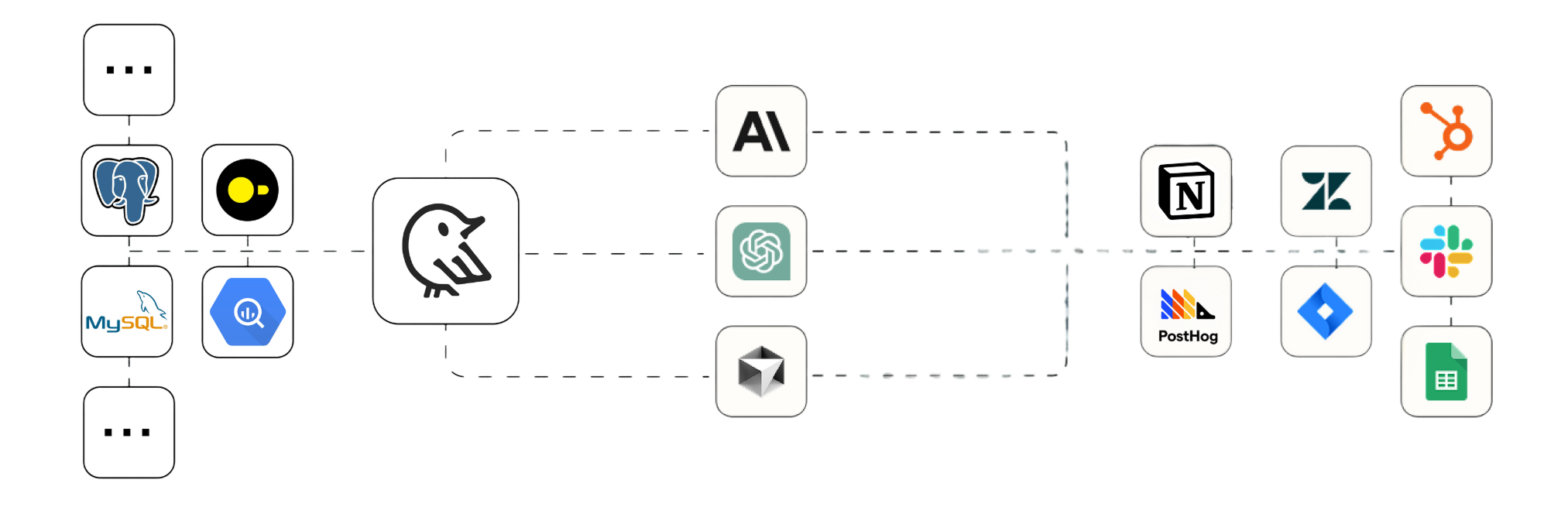
At the enterprise level, the stakes - and the complexity - are much higher. Businesses run on structured data stored in cloud warehouses, relational databases, and secure filesystems. From BI dashboards to CRM updates and compliance workflows, AI must not only execute commands but also understand and retrieve the right data, with precision and in context.
While many community and official MCP servers already support connections to major databases like PostgreSQL, MySQL, SQL Server, and more, there's a problem: raw access to data isn't enough.
Enterprises need:
Accurate semantic understanding of their data models
Trusted calculations and aggregations in reporting
Clarity on business terms, like "active customer," "net revenue," or "churn rate"
User-based permissions and access control
Natural language alone isn't enough to drive complex workflows across enterprise data systems. You need a layer that interprets intent, maps it to the correct data, applies calculations accurately, and ensures security.
Wren Engine is on a mission to power the future of MCP clients and AI agents through the Model Context Protocol (MCP) — a new open standard that connects LLMs with tools, databases, and enterprise systems.
As part of the MCP ecosystem, Wren Engine provides a semantic engine powered the next generation semantic layer that enables AI agents to access business data with accuracy, context, and governance.
By building the semantic layer directly into MCP clients, such as Claude, Cline, Cursor, etc. Wren Engine empowers AI Agents with precise business context and ensures accurate data interactions across diverse enterprise environments.
We believe the future of enterprise AI lies in context-aware, composable systems. That’s why Wren Engine is designed to be:
🔌 Embeddable into any MCP client or AI agentic workflow
🔄 Interoperable with modern data stacks (PostgreSQL, MySQL, Snowflake, etc.)
🧠 Semantic-first, enabling AI to “understand” your data model and business logic
🔐 Governance-ready, respecting roles, access controls, and definitions
With Wren Engine, you can scale AI adoption across teams — not just with better automation, but with better understanding.
Check our full article
https://github.com/user-attachments/assets/dab9b50f-70d7-4eb3-8fc8-2ab55dc7d2ec
👉 Blog Post Tutorial: Powering AI-driven workflows with Wren Engine and Zapier via the Model Context Protocol (MCP)
Wren Engine is currently in the beta version. The project team is actively working on progress and aiming to release new versions at least biweekly.
The project consists of 4 main modules:
Install via CLI
npx mdskills install Canner/wren-engineWren Engine is a free, open-source AI agent skill. Wren Engine - Google Cloud Storage - Local Files - MS SQL Server - MySQL Server - Oracle Server - PostgreSQL Server - Amazon S3 - Snowflake - Databricks - Apache Spark At the enterprise level, the stakes - and the complexity - are much higher. Businesses run on structured data stored in cloud warehouses, relational databases, and secure filesystems. From BI dashboards to CRM updates and compliance
Install Wren Engine with a single command:
npx mdskills install Canner/wren-engineThis downloads the skill files into your project and your AI agent picks them up automatically.
Wren Engine works with Claude Code, Claude Desktop, Cursor, Vscode Copilot, Windsurf, Continue Dev, Codex, Gemini Cli, Amp, Roo Code, Goose, Opencode, Trae, Qodo, Command Code, Databricks. Skills use the open SKILL.md format which is compatible with any AI coding agent that reads markdown instructions.