
Vexor is a semantic search engine that builds reusable indexes over files and code. It supports configurable embedding and reranking providers, and exposes the same core through a Python API, a CLI tool, and an optional desktop frontend. Vexor Demo Video Vexor has been recognized and featured by the community: - Ruan Yifeng's Weekly (Issue 379) - A leading tech newsletter in the Chinese developer
npx mdskills install scarletkc/vexorRelated
@scarletkc? Sign in with GitHub to claim this listing.Provides no actionable instructions or guidance for semantic file search functionality

Vexor is a semantic search engine that builds reusable indexes over files and code. It supports configurable embedding and reranking providers, and exposes the same core through a Python API, a CLI tool, and an optional desktop frontend.
Vexor Demo Video
Vexor has been recognized and featured by the community:
When you remember what a file does but forget its name or location, Vexor finds it instantly—no grep patterns or directory traversal needed.
Designed for both humans and AI coding assistants, enabling semantic file discovery in autonomous agent workflows.
Download standalone binary from releases (no Python required), or:
pip install vexor # also works with pipx, uv
vexor init
The wizard also runs automatically on first use when no config exists.
vexor "api client config"  # defaults to search current directory
# or explicit path:
vexor search "api client config" --path ~/projects/demo --top 5
# in-memory search only:
vexor search "api client config" --no-cache
Vexor auto-indexes on first search. Example output:
Vexor semantic file search results
──────────────────────────────────
#   Similarity   File path                       Lines   Preview
1   0.923        ./src/config_loader.py          -       config loader entrypoint
2   0.871        ./src/utils/config_parse.py     -       parse config helpers
3   0.809        ./tests/test_config_loader.py   -       tests for config loader
vexor index  # indexes current directory
# or explicit path:
vexor index --path ~/projects/demo --mode code
Useful for CI warmup or when auto_index is disabled.
The desktop app is experimental and not actively maintained. It may be unstable. For production use, prefer the CLI.
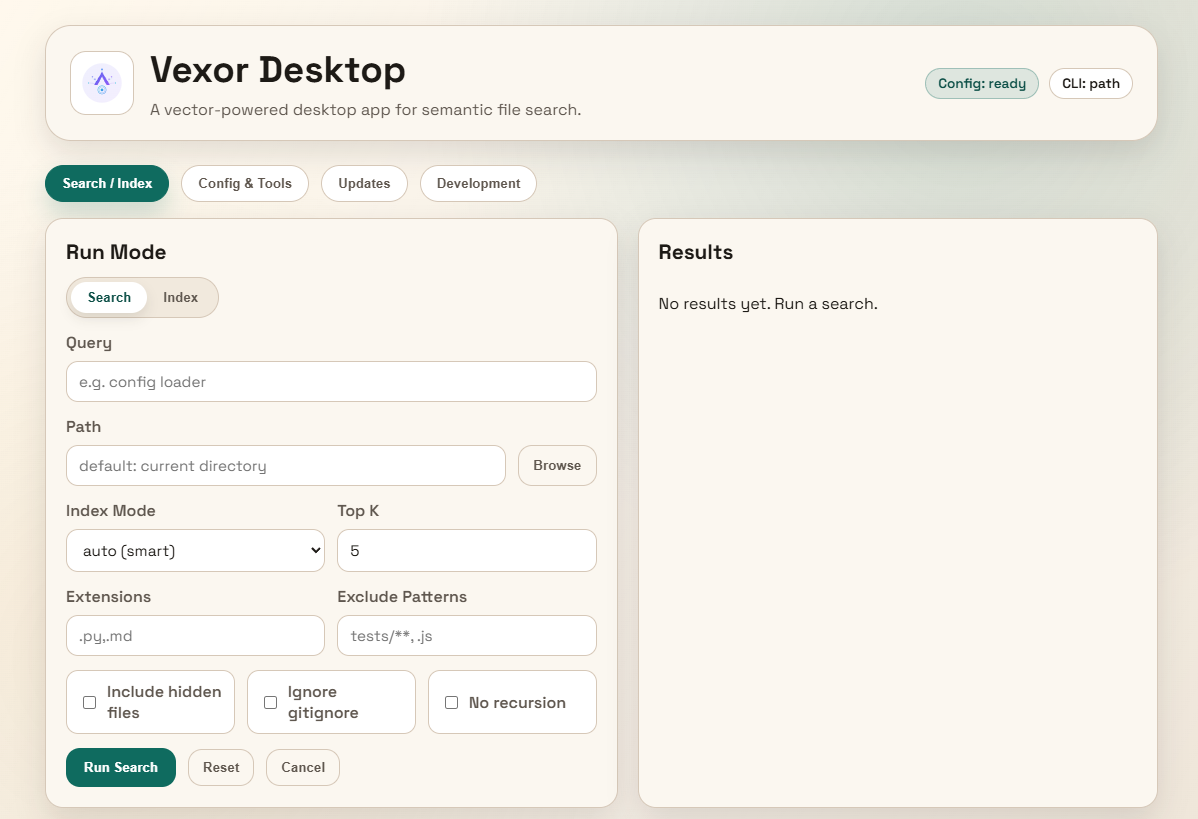
Download the desktop app from releases.
Vexor can also be imported and used directly from Python:
from vexor import index, search

index(path=".", mode="head")
response = search("config loader", path=".", mode="name")

for hit in response.results:
    print(hit.path, hit.score)
By default it reads ~/.vexor/config.json. For runtime config overrides, cache
controls, and per-call options, see docs/api/python.md.
This repo includes a skill for AI agents to use Vexor effectively:
vexor install --skills claude  # Claude Code
vexor install --skills codex   # Codex
Skill source: plugins/vexor/skills/vexor-cli
vexor config --set-provider openai          # default; also supports gemini/voyageai/custom/local
vexor config --set-model text-embedding-3-small
vexor config --set-provider voyageai        # uses voyage defaults when model/base_url are unset
vexor config --set-batch-size 0             # 0 = single request
vexor config --set-embed-concurrency 4       # parallel embedding requests
vexor config --set-extract-concurrency 4     # parallel file extraction workers
vexor config --set-extract-backend auto      # auto|thread|process (default: auto)
vexor config --set-embedding-dimensions 1024 # optional, model/provider dependent
vexor config --clear-embedding-dimensions    # reset to model default dimension
vexor config --set-auto-index true          # auto-index before search (default)
vexor config --rerank bm25                  # optional BM25 rerank for top-k results
vexor config --rerank flashrank             # FlashRank rerank (requires optional extra)
vexor config --rerank remote                # remote rerank via HTTP endpoint
vexor config --set-flashrank-model ms-marco-MultiBERT-L-12  # multilingual model
vexor config --set-flashrank-model          # reset FlashRank model to default
vexor config --clear-flashrank              # remove cached FlashRank models
vexor config --set-remote-rerank-url https://proxy.example.com/v1/rerank
vexor config --set-remote-rerank-model bge-reranker-v2-m3
vexor config --set-remote-rerank-api-key $VEXOR_REMOTE_RERANK_API_KEY  # or env var
vexor config --clear-remote-rerank          # clear remote rerank config
vexor config --set-base-url https://proxy.example.com  # optional proxy
vexor config --clear-base-url               # reset to official endpoint
vexor config --show                         # view current settings
Rerank defaults to off. It is highly recommended to configure the Reranker in advance to improve search accuracy.
FlashRank requires pip install "vexor[flashrank]" and caches models under ~/.vexor/flashrank.
Config stored in ~/.vexor/config.json.
vexor config --set-api-key "YOUR_KEY"
Or via environment: VEXOR_API_KEY, OPENAI_API_KEY, GOOGLE_GENAI_API_KEY, or VOYAGE_API_KEY.
Rerank reorders the semantic results with a secondary ranker. Candidate sizing uses
clamp(int(--top * 2), 20, 150).
Recommended defaults:
off unless you want extra precision.bm25 for lightweight lexical boosts; it is fast and lightweight.flashrank for stronger reranking (requires pip install "vexor[flashrank]" and
downloads a model to ~/.vexor/flashrank).remote to call a hosted reranker that accepts {model, query, documents} and
returns ranked indexes.--set-flashrank-model ms-marco-MultiBERT-L-12.ms-marco-TinyBERT-L-2-v2.Vexor supports both remote API providers (openai, gemini, voyageai, custom) and a local provider (local):
api_key and optional base_url.voyageai defaults to https://api.voyageai.com/v1 when base_url is not set.custom is OpenAI-compatible and requires both model and base_url.api_key/base_url and only uses model plus local_cuda (CPU/GPU switch).Embedding dimensions are optional. If unset, the provider/model default is used. Custom dimensions are validated for:
text-embedding-3-*voyage-3* and voyage-code-3*vexor config --set-embedding-dimensions 1024
vexor config --clear-embedding-dimensions
If you change dimensions after an index is built, rebuild the index:
vexor index --path .
Install the lightweight local backend:
pip install "vexor[local]"
GPU backend (requires CUDA drivers):
pip install "vexor[local-cuda]"
Download a local embedding model and auto-configure Vexor:
vexor local --setup --model intfloat/multilingual-e5-small
Then use vexor search / vexor index as usual.
Local models are stored in ~/.vexor/models (clear with vexor local --clean-up).
GPU (optional): install onnxruntime-gpu (or vexor[local-cuda]) and use vexor local --setup --cuda (or vexor local --cuda).
Switch back with vexor local --cpu.
Control embedding granularity with --mode:
| Mode | Description |
|---|---|
auto | Default. Smart routing: Python/JS/TS → code, Markdown → outline, small files → full, large files → head |
name | Embed filename only (fastest, zero content reads) |
head | Extract first snippet for lightweight semantic context |
brief | Extract high-frequency keywords from PRDs/requirements docs |
full | Chunk entire content; long documents searchable end-to-end |
code | AST-aware chunking by module/class/function boundaries for Python and JavaScript/TypeScript; other files fall back to full |
outline | Chunk Markdown by heading hierarchy with breadcrumbs; non-.md falls back to full |
Index cache keys derive from: --path, --mode, --include-hidden, --no-recursive, --no-respect-gitignore, --ext, --exclude-pattern.
Keep flags consistent to reuse cache; changing flags creates a separate index.
vexor config --show-index-all    # list all cached indexes
vexor config --clear-index-all   # clear all cached indexes
vexor index --path . --clear     # clear index for specific path
Re-running vexor index only re-embeds changed files; >50% changes trigger full rebuild.
| Command | Description |
|---|---|
vexor init | Run the interactive setup wizard |
vexor QUERY | Shortcut for vexor search QUERY |
vexor search QUERY --path PATH | Semantic search (auto-indexes if needed) |
vexor index --path PATH | Build/refresh index manually |
vexor config --show | Display current configuration |
vexor config --clear-flashrank | Remove cached FlashRank models under ~/.vexor/flashrank |
vexor local --setup [--model MODEL] | Download a local model and set provider to local |
vexor local --clean-up | Remove local model cache under ~/.vexor/models |
vexor local --cuda | Enable CUDA for local embeddings (requires onnxruntime-gpu) |
vexor local --cpu | Disable CUDA and use CPU for local embeddings |
vexor install --skills claude | Install Agent Skill for Claude Code |
vexor install --skills codex | Install Agent Skill for Codex |
vexor doctor | Run diagnostic checks (command, config, cache, API key, API connectivity) |
vexor update [--upgrade] [--pre] | Check for new version (optionally upgrade; --pre includes pre-releases) |
vexor feedback | Open GitHub issue form (or use gh) |
vexor alias | Print a shell alias for vx and optionally apply it |
| Flag | Description |
|---|---|
--path PATH | Target directory (default: current working directory) |
--mode MODE | Index mode (auto/name/head/brief/full/code/outline) |
--top K / -k | Number of results (default: 5) |
--ext .py,.md / -e | Filter by extension (repeatable) |
--exclude-pattern PATTERN | Exclude paths by gitignore-style pattern (repeatable; .js treated as **/*.js) |
--include-hidden / -i | Include hidden files |
--no-recursive / -n | Don't recurse into subdirectories |
--no-respect-gitignore | Include gitignored files |
--format porcelain | Script-friendly TSV output |
--format porcelain-z | NUL-delimited output |
--no-cache | In-memory only; do not read/write index cache |
Porcelain output fields: rank, similarity, path, chunk_index, start_line, end_line, preview (line fields are - when unavailable).
See docs for more details.
Contributions, issues, and PRs welcome! Star if you find it helpful.
Install via CLI
npx mdskills install scarletkc/vexorVexor is a free, open-source AI agent skill. Vexor is a semantic search engine that builds reusable indexes over files and code. It supports configurable embedding and reranking providers, and exposes the same core through a Python API, a CLI tool, and an optional desktop frontend. Vexor Demo Video Vexor has been recognized and featured by the community: - Ruan Yifeng's Weekly (Issue 379) - A leading tech newsletter in the Chinese developer
Install Vexor with a single command:
npx mdskills install scarletkc/vexorThis downloads the skill files into your project and your AI agent picks them up automatically.
Vexor works with Claude Code, Claude Desktop, Cursor, Vscode Copilot, Windsurf, Continue Dev, Codex, Gemini Cli, Amp, Roo Code, Goose, Opencode, Trae, Qodo, Command Code. Skills use the open SKILL.md format which is compatible with any AI coding agent that reads markdown instructions.
