
Publish updated MCP server metadata to the MCP Registry
npx mdskills install danmartuszewski/publish-mcpRelated
@danmartuszewski? Sign in with GitHub to claim this listing.Well-structured release automation with clear steps, appropriate tooling, and proper version control flow

hop
Stop typing long SSH commands. Just hop prod and you're in.
# Before: remembering and typing this every time
ssh -i ~/.ssh/work_key deploy@app-server-prod-03.us-east-1.example.com -p 2222

# After
hop prod
hop prod                         # fuzzy match any server
hop exec production "uptime"     # run command on all prod servers
hop import                       # import your existing ~/.ssh/config
hop                              # launch the TUI, manage everything
brew install danmartuszewski/tap/hop
go install github.com/danmartuszewski/hop/cmd/hop@latest
git clone https://github.com/danmartuszewski/hop.git && cd hop && make build
./bin/hop
hop prod to connect to app-server-prod-03~/.ssh/config? Import them in one commandSee all features in action: Demo recordings
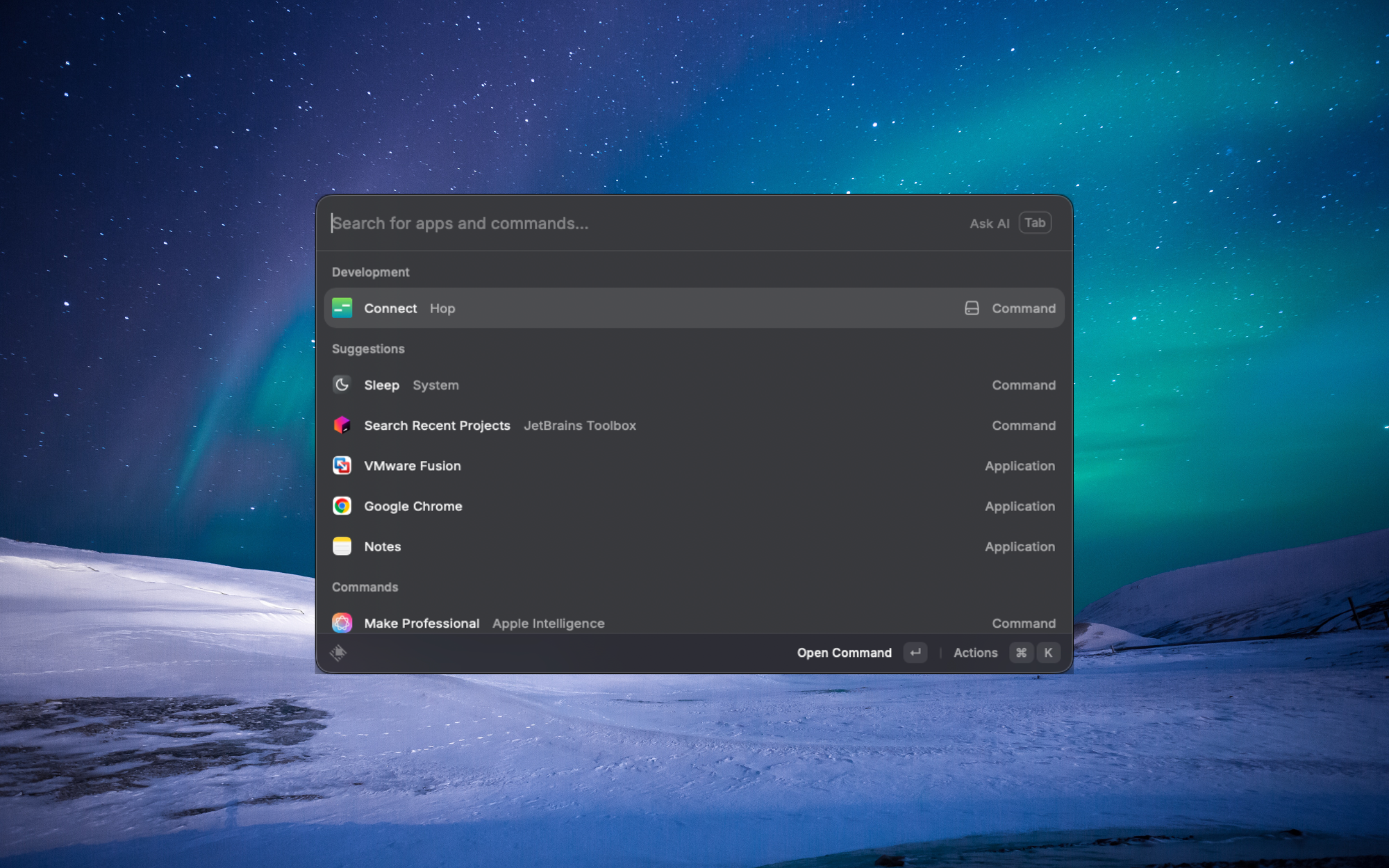
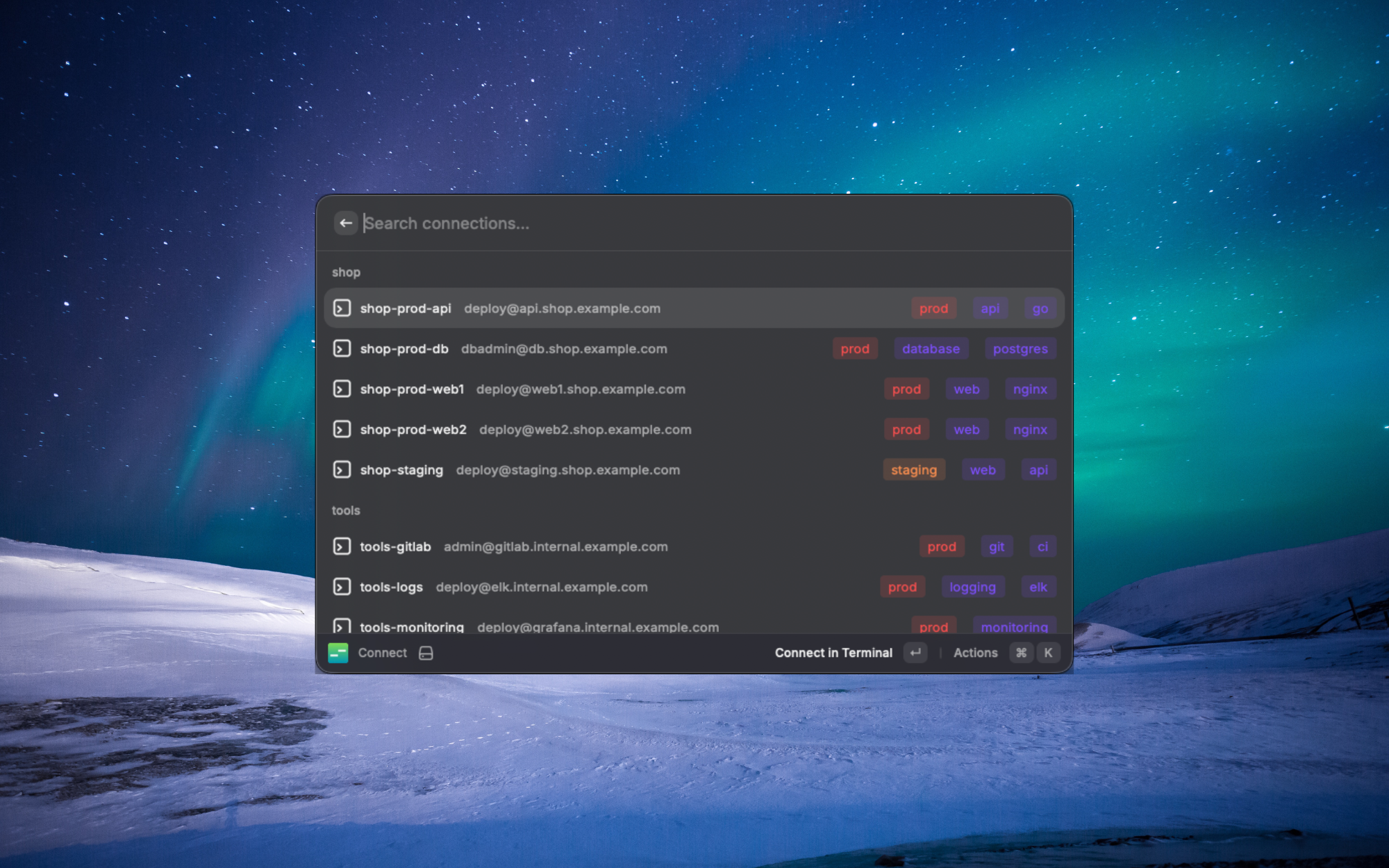
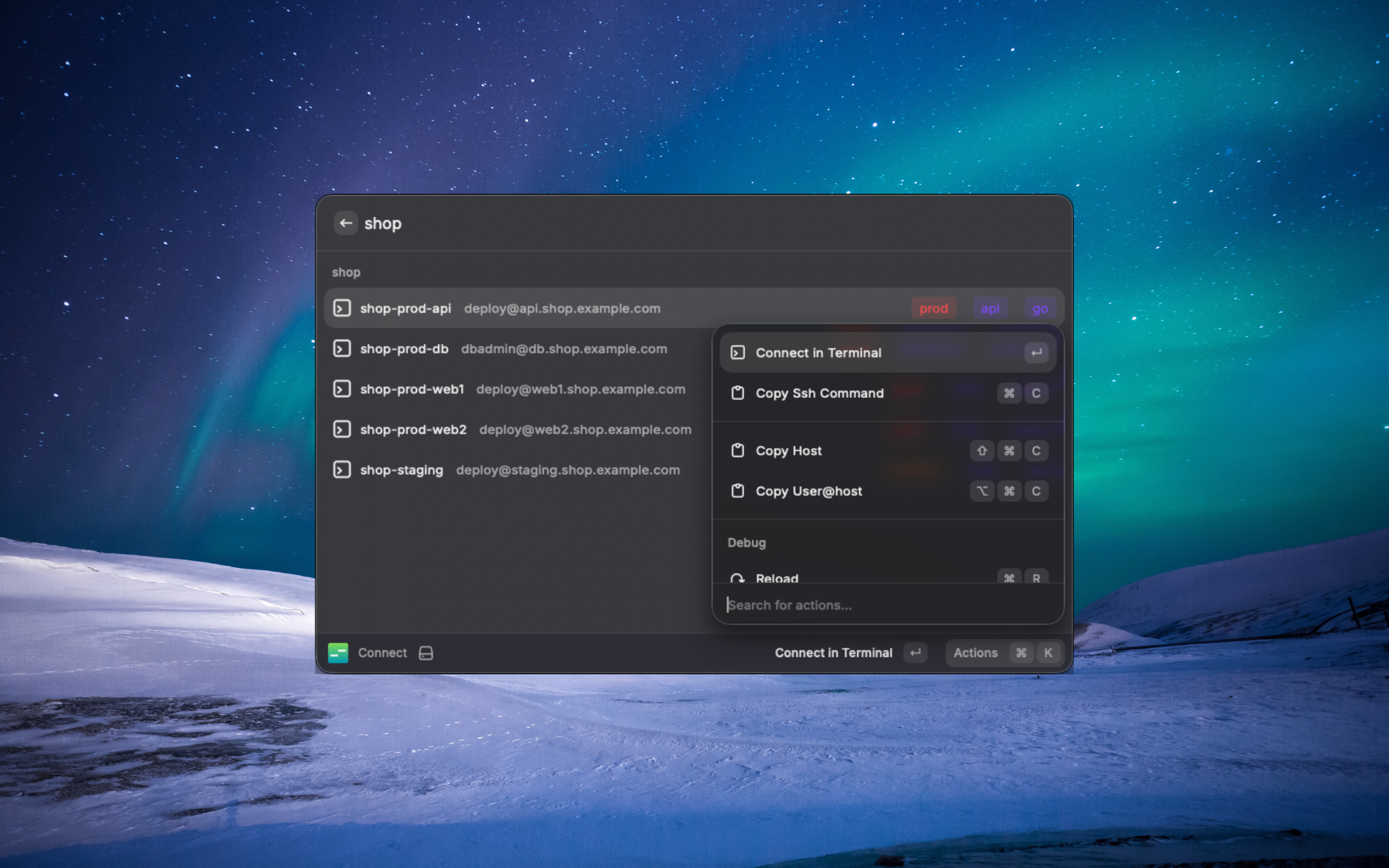
Launch connections directly from Raycast. Fuzzy search, tags, environments - all at your fingertips.
Config file location: ~/.config/hop/config.yaml
version: 1

defaults:
  user: admin
  port: 22

connections:
  - id: prod-web
    host: web.example.com
    user: deploy
    project: myapp
    env: production
    tags: [web, prod]

  - id: prod-db
    host: db.example.com
    user: dbadmin
    port: 5432
    project: myapp
    env: production
    tags: [database, prod]

  - id: staging
    host: staging.example.com
    user: deploy
    project: myapp
    env: staging

  - id: private-server
    host: 10.0.1.50
    user: admin
    proxy_jump: bastion          # Connect via jump host
    forward_agent: true          # Forward SSH agent

groups:
  production: [prod-web, prod-db]
  web-servers: [prod-web, staging]
Security note:
forward_agent: trueexposes your SSH keys to anyone with root access on the remote server. Only enable this for servers you fully trust. Consider usingproxy_jumpinstead when you just need to reach internal hosts through a bastion.
Launch with hop or hop dashboard.
When you connect to a server from the dashboard (by pressing Enter), the SSH session starts, and the dashboard automatically returns after the session ends. This lets you quickly hop between servers without restarting the TUI each time.
For one-shot connections that exit to your terminal, use:
hop            # fuzzy match and connect
hop connect       # connect by exact ID
| Key | Action |
|---|---|
↑/k | Move up |
↓/j | Move down |
PgUp/PgDn | Move by page |
g | Go to top |
G | Go to bottom |
/ | Filter connections (supports multi-keyword AND search) |
t | Filter by tags |
r | Toggle sort by recent |
Enter | Connect to selected |
a | Add new connection |
i | Import from SSH config |
p | Paste SSH string (quick add) |
e | Edit selected |
c | Duplicate selected |
d | Delete selected |
x | Export connections to YAML |
y | Copy SSH command |
? | Show help |
q | Quit |
Press / to filter connections by typing keywords. The filter supports multi-keyword AND logic - separate keywords with spaces to find connections matching all terms.
Examples:
prod - matches connections containing "prod"prod web - matches connections containing both "production" AND "web"kaf staging - matches connections with both "kafka" AND "staging"The filter searches across connection IDs, hosts, projects, environments, and tags.
Press p and paste any of these formats:
user@host.com
user@host.com:2222
ssh user@host.com -p 2222
ssh://user@host:port
The connection form opens with fields pre-filled.
Import existing connections from your ~/.ssh/config file:
From the dashboard: Press i to open the import modal, select which connections to import, and press Enter.
From the CLI:
hop import                   # Import from ~/.ssh/config
hop import --dry-run         # Preview what would be imported
hop import --file ~/.ssh/config.d/work  # Import from custom path
What gets imported:
What gets skipped:
Host *, Host *.example.com)Conflict handling: If a connection ID already exists, the imported connection is renamed with -imported suffix (e.g., myserver → myserver-imported).
Export a subset of connections to a YAML file for sharing, backup, or transferring to another machine.
From the dashboard: Press x to open the export modal. Only currently filtered connections are shown — apply text or tag filters first to narrow the selection. Toggle items with Space, then press Enter to save.
From the CLI:
hop export --all                          # Export all to stdout
hop export --all -o backup.yaml           # Export all to a file
hop export --project myapp -o myapp.yaml  # Export by project
hop export --tag database                 # Export by tag
hop export --env production               # Export by environment
hop export --id web-1,web-2              # Export specific connections
At least one filter flag or --all is required. Filters combine with AND logic.
hop                          # Open TUI dashboard
hop                   # Fuzzy match and connect
hop connect              # Connect by exact ID
hop list                     # List all connections
hop list --json              # List as JSON
hop list --flat              # Flat list without grouping
hop import                   # Import from ~/.ssh/config
hop import --file      # Import from custom path
hop import --dry-run         # Preview without importing
hop export --all             # Export all connections to stdout
hop export --project   # Export filtered connections
hop export --tag  -o f  # Export to file
hop open          # Open multiple terminal tabs
hop exec  "cmd"      # Execute command on multiple servers
hop resolve          # Test which connections a target matches
hop mcp                      # Start MCP server (read-only)
hop mcp --allow-exec         # Start MCP server with remote exec
hop version                  # Show version
Commands like exec and open accept a target that resolves to one or more connections. The target is matched in this order:
groups: in configproject and env fields (e.g. myapp-prod matches all connections with project: myapp and env: prod)web*, *-prod-*)You can also filter any target by tag with --tag.
Use hop resolve to preview which connections a target will match before running anything:
hop resolve production              # see what "production" resolves to
hop resolve "web*"                  # test a glob pattern
hop resolve myapp-prod --tag=web    # combine target + tag filter
# Fuzzy connect
hop prod                # matches "prod-web", "prod-db", etc.
hop web                 # matches first *web* server

# Multi-exec with different target types
hop exec production "uptime"           # named group
hop exec myapp-prod "df -h"            # project-env pattern
hop exec "web*" "systemctl status"     # glob pattern
hop exec --tag=database "psql -c '\\l'" # tag filter

# Open multiple tabs
hop open production                    # named group
hop open web1 db1 api1                 # specific IDs
hop open myapp-prod -- "htop"          # with initial command

# List connections
hop list --flat
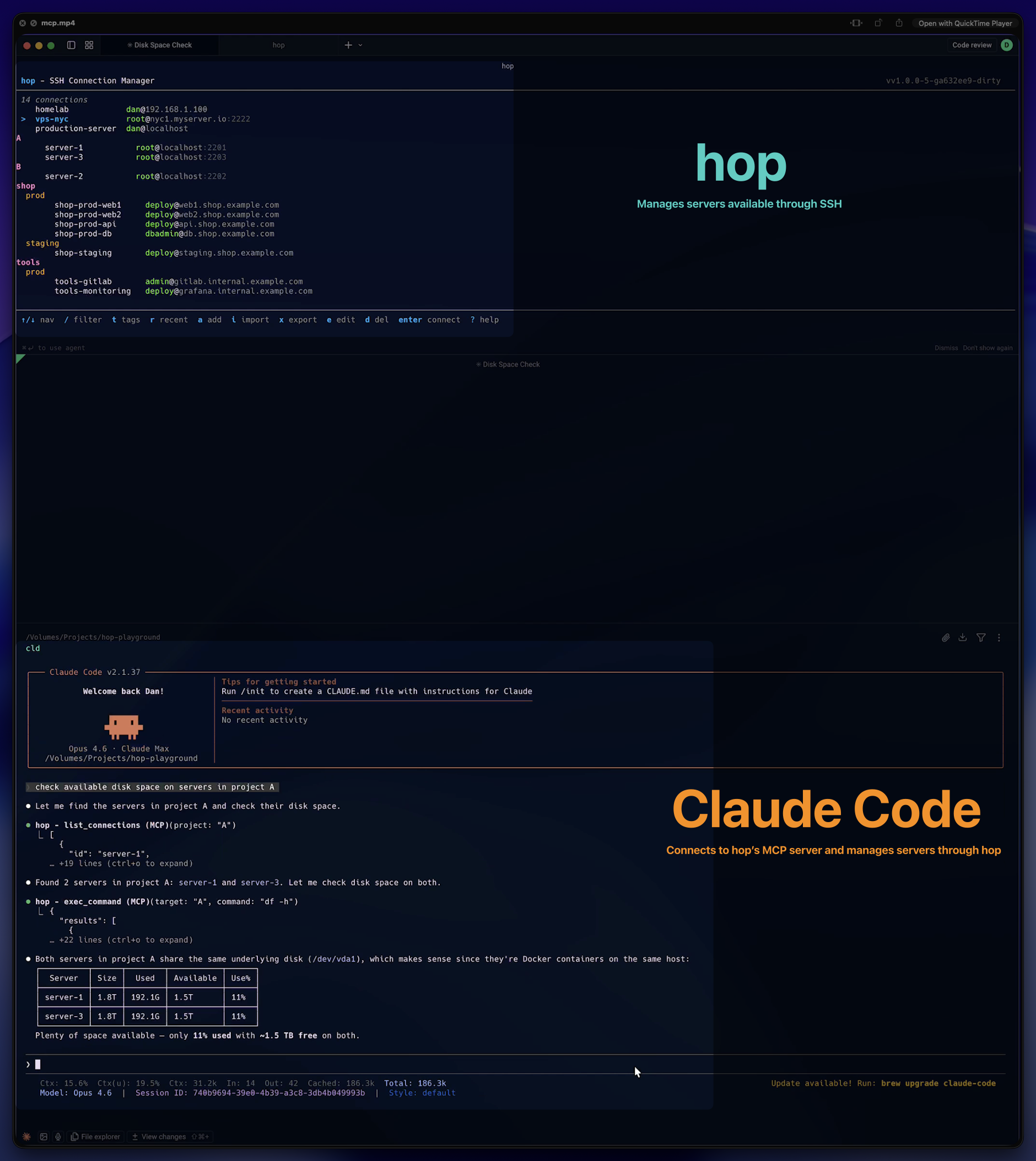
hop includes a built-in Model Context Protocol server that lets AI assistants like Claude Code and Codex manage your servers directly. Ask your assistant to check disk space across production, restart a service on staging, or find which servers belong to a project — it discovers your connections, resolves targets, and executes commands through hop.
Claude Code:
claude mcp add hop -- hop mcp
Codex CLI:
codex mcp add hop -- hop mcp
Claude Desktop — add to your config (~/Library/Application Support/Claude/claude_desktop_config.json):
{
  "mcpServers": {
    "hop": {
      "command": "hop",
      "args": ["mcp"]
    }
  }
}
Codex — add to ~/.codex/config.toml:
[mcp_servers.hop]
command = "hop"
args = ["mcp"]
Or generate the Claude Desktop config automatically:
hop mcp --print-client-config                  # read-only
hop mcp --print-client-config --allow-exec     # with remote exec enabled
By default, only read-only tools are exposed:
| Tool | Description |
|---|---|
list_connections | List connections, filter by project/env/tag |
search_connections | Fuzzy search across all connections |
get_connection | Get details for a specific connection |
resolve_target | Preview how a target pattern resolves |
list_groups | List all named groups |
get_history | Connection usage history |
build_ssh_command | Build the full SSH command string |
To enable remote command execution, start with --allow-exec:
claude mcp add hop -- hop mcp --allow-exec
codex mcp add hop -- hop mcp --allow-exec
This adds the exec_command tool, which runs shell commands on matched servers with output limits (64KB/host, 50 hosts max).
The server also exposes browsable resources:
| URI | Description |
|---|---|
hop://config | Config summary (counts, projects, environments) |
hop://connections | All connections |
hop://connections/{id} | Individual connection details |
hop://groups | All groups and members |
--allow-exec# Bash (Linux)
hop completion bash | sudo tee /etc/bash_completion.d/hop > /dev/null
# Bash (macOS with Homebrew)
hop completion bash > $(brew --prefix)/etc/bash_completion.d/hop
# Zsh (add to ~/.zshrc)
source ~/.config/fish/completions/hop.fish
-c, --config     # Use custom config file
-v, --verbose          # Verbose output
-q, --quiet            # Suppress non-essential output
    --dry-run          # Print SSH command without executing
make build          # Build binary to ./bin/hop
make test           # Run tests
make test-docker    # Run tests in Docker (isolated)
make install        # Install to $GOPATH/bin
make docker         # Build Docker image
# Build image
docker build -t hop .

# Run interactively
docker run -it --rm hop

# Run tests in container
docker build --target tester -t hop-test .
hop/
├── cmd/hop/           # Main entry point
├── internal/
│   ├── cmd/           # CLI commands (cobra)
│   ├── config/        # Configuration loading/saving
│   ├── export/        # Export logic
│   ├── fuzzy/         # Fuzzy matching
│   ├── mcp/           # MCP server (tools, resources, types)
│   ├── picker/        # Connection picker (promptui)
│   ├── resolve/       # Target resolution logic
│   ├── ssh/           # SSH connection handling
│   ├── sshconfig/     # SSH config parsing
│   └── tui/           # TUI dashboard (bubbletea)
├── Dockerfile
├── Makefile
└── README.md
MIT License - see LICENSE for details.
Best experience: Claude Code
/plugin marketplace add danmartuszewski/publish-mcpThen /plugin menu → select skill → restart. Use /skill-name:init for first-time setup.
Other platforms
Install via CLI
npx mdskills install danmartuszewski/publish-mcpPublish MCP is a free, open-source AI agent skill. Publish updated MCP server metadata to the MCP Registry
Install Publish MCP with a single command:
npx mdskills install danmartuszewski/publish-mcpThis downloads the skill files into your project and your AI agent picks them up automatically.
Publish MCP works with Claude Code, Claude Desktop, Cursor, Vscode Copilot, Windsurf, Continue Dev, Codex, Gemini Cli, Amp, Roo Code, Goose, Opencode, Trae, Qodo, Command Code. Skills use the open SKILL.md format which is compatible with any AI coding agent that reads markdown instructions.