
Persistent memory and knowledge management. Use at session start to load context, when the user asks about past work or stored knowledge, and when saving important information for future sessions.
npx mdskills install agentic-mcp-tools/memoraRelated
@agentic-mcp-tools? Sign in with GitHub to claim this listing.Clear actionable workflow for persistent memory management across sessions with appropriate permissions
Memora
"You never truly know the value of a moment until it becomes a memory."
Give your AI agents persistent memory
A lightweight MCP server for semantic memory storage, knowledge graphs, conversational recall, and cross-session context.
Features · Install · Usage · Config · Live Graph · Cloud Graph · Chat · Semantic Search · LLM Dedup · Linking · Neovim
Core Storage
Search & Intelligence
Tools & Visualization
pip install git+https://github.com/agentic-mcp-tools/memora.git
Includes cloud storage (S3/R2) and OpenAI embeddings out of the box.
# Optional: local embeddings (offline, ~2GB for PyTorch)
pip install "memora[local]" @ git+https://github.com/agentic-mcp-tools/memora.git
Usage
The server runs automatically when configured in Claude Code. Manual invocation:
# Default (stdio mode for MCP)
memora-server

# With graph visualization server
memora-server --graph-port 8765

# HTTP transport (alternative to stdio)
memora-server --transport streamable-http --host 127.0.0.1 --port 8080
Configuration
Add to .mcp.json in your project root:
Local DB:
{
  "mcpServers": {
    "memora": {
      "command": "memora-server",
      "args": [],
      "env": {
        "MEMORA_DB_PATH": "~/.local/share/memora/memories.db",
        "MEMORA_ALLOW_ANY_TAG": "1",
        "MEMORA_GRAPH_PORT": "8765"
      }
    }
  }
}
Cloud DB (Cloudflare D1) - Recommended:
{
  "mcpServers": {
    "memora": {
      "command": "memora-server",
      "args": ["--no-graph"],
      "env": {
        "MEMORA_STORAGE_URI": "d1:///",
        "CLOUDFLARE_API_TOKEN": "",
        "MEMORA_ALLOW_ANY_TAG": "1"
      }
    }
  }
}
With D1, use --no-graph to disable the local visualization server. Instead, use the hosted graph at your Cloudflare Pages URL (see Cloud Graph).
Cloud DB (S3/R2) - Sync mode:
{
  "mcpServers": {
    "memora": {
      "command": "memora-server",
      "args": [],
      "env": {
        "AWS_PROFILE": "memora",
        "AWS_ENDPOINT_URL": "https://.r2.cloudflarestorage.com",
        "MEMORA_STORAGE_URI": "s3://memories/memories.db",
        "MEMORA_CLOUD_ENCRYPT": "true",
        "MEMORA_ALLOW_ANY_TAG": "1",
        "MEMORA_GRAPH_PORT": "8765"
      }
    }
  }
}
Add to ~/.codex/config.toml:
[mcp_servers.memora]
  command = "memora-server"  # or full path: /path/to/bin/memora-server
  args = ["--no-graph"]
  env = {
    AWS_PROFILE = "memora",
    AWS_ENDPOINT_URL = "https://.r2.cloudflarestorage.com",
    MEMORA_STORAGE_URI = "s3://memories/memories.db",
    MEMORA_CLOUD_ENCRYPT = "true",
    MEMORA_ALLOW_ANY_TAG = "1",
  }
Environment Variables
| Variable | Description |
|---|---|
MEMORA_DB_PATH | Local SQLite database path (default: ~/.local/share/memora/memories.db) |
MEMORA_STORAGE_URI | Storage URI: d1:/// (D1) or s3://bucket/memories.db (S3/R2) |
CLOUDFLARE_API_TOKEN | API token for D1 database access (required for d1:// URI) |
MEMORA_CLOUD_ENCRYPT | Encrypt database before uploading to cloud (true/false) |
MEMORA_CLOUD_COMPRESS | Compress database before uploading to cloud (true/false) |
MEMORA_CACHE_DIR | Local cache directory for cloud-synced database |
MEMORA_ALLOW_ANY_TAG | Allow any tag without validation against allowlist (1 to enable) |
MEMORA_TAG_FILE | Path to file containing allowed tags (one per line) |
MEMORA_TAGS | Comma-separated list of allowed tags |
MEMORA_GRAPH_PORT | Port for the knowledge graph visualization server (default: 8765) |
MEMORA_EMBEDDING_MODEL | Embedding backend: openai (default), sentence-transformers, or tfidf |
SENTENCE_TRANSFORMERS_MODEL | Model for sentence-transformers (default: all-MiniLM-L6-v2) |
OPENAI_API_KEY | API key for OpenAI embeddings and LLM deduplication |
OPENAI_BASE_URL | Base URL for OpenAI-compatible APIs (OpenRouter, Azure, etc.) |
OPENAI_EMBEDDING_MODEL | OpenAI embedding model (default: text-embedding-3-small) |
MEMORA_LLM_ENABLED | Enable LLM-powered deduplication comparison (true/false, default: true) |
MEMORA_LLM_MODEL | Model for deduplication comparison (default: gpt-4o-mini) |
CHAT_MODEL | Model for the chat panel (default: deepseek/deepseek-chat, falls back to MEMORA_LLM_MODEL) |
AWS_PROFILE | AWS credentials profile from ~/.aws/credentials (useful for R2) |
AWS_ENDPOINT_URL | S3-compatible endpoint for R2/MinIO |
R2_PUBLIC_DOMAIN | Public domain for R2 image URLs |
Semantic Search & Embeddings
Memora supports three embedding backends:
| Backend | Install | Quality | Speed |
|---|---|---|---|
openai (default) | Included | High quality | API latency |
sentence-transformers | pip install memora[local] | Good, runs offline | Medium |
tfidf | Included | Basic keyword matching | Fast |
Automatic: Embeddings and cross-references are computed automatically when you memory_create, memory_update, or memory_create_batch.
Manual rebuild required when:
MEMORA_EMBEDDING_MODEL after memories exist# After changing embedding model, rebuild all embeddings
memory_rebuild_embeddings
# Then rebuild cross-references to update the knowledge graph
memory_rebuild_crossrefs
Live Graph Server
A built-in HTTP server starts automatically with the MCP server, serving an interactive knowledge graph visualization.
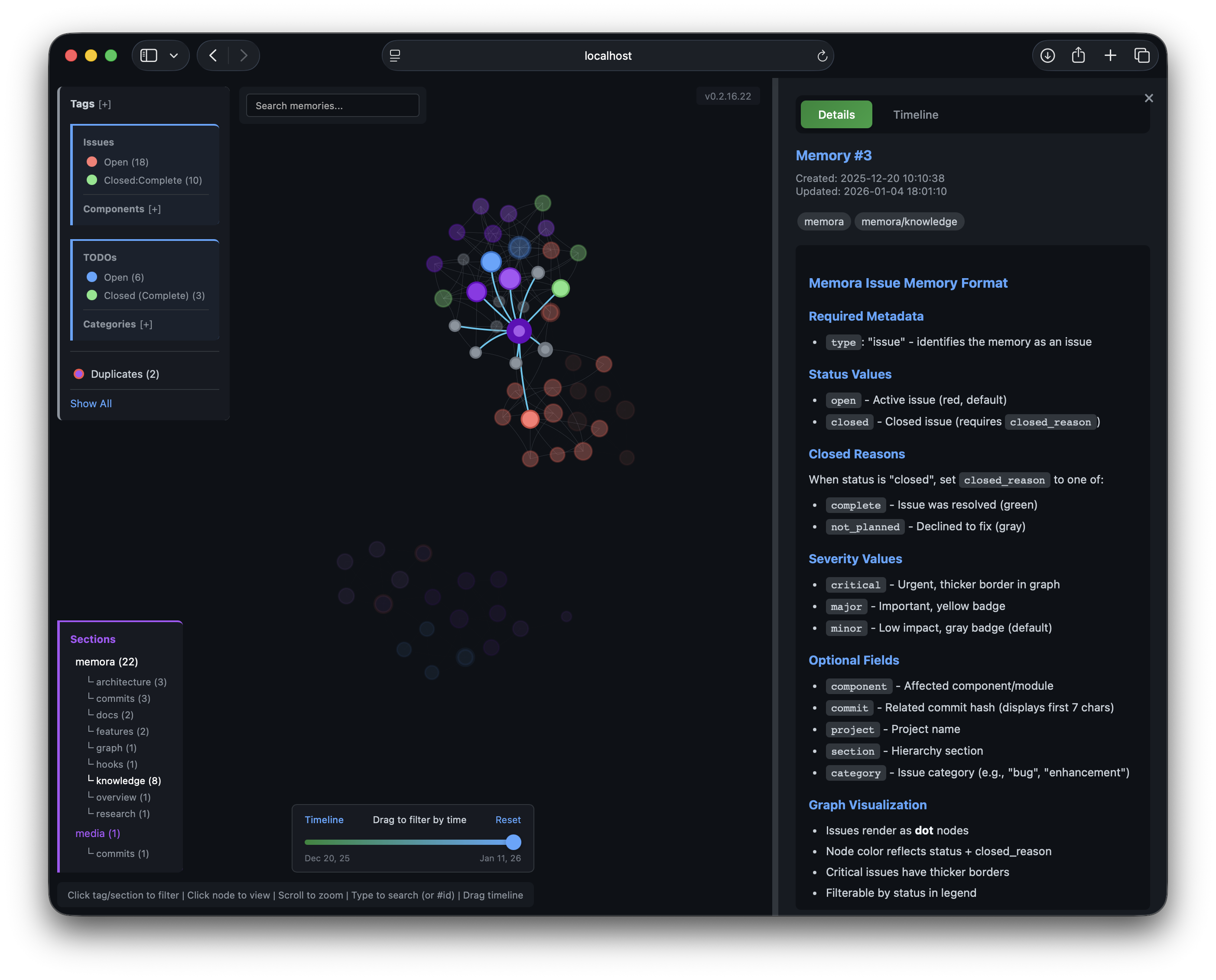 Details Panel
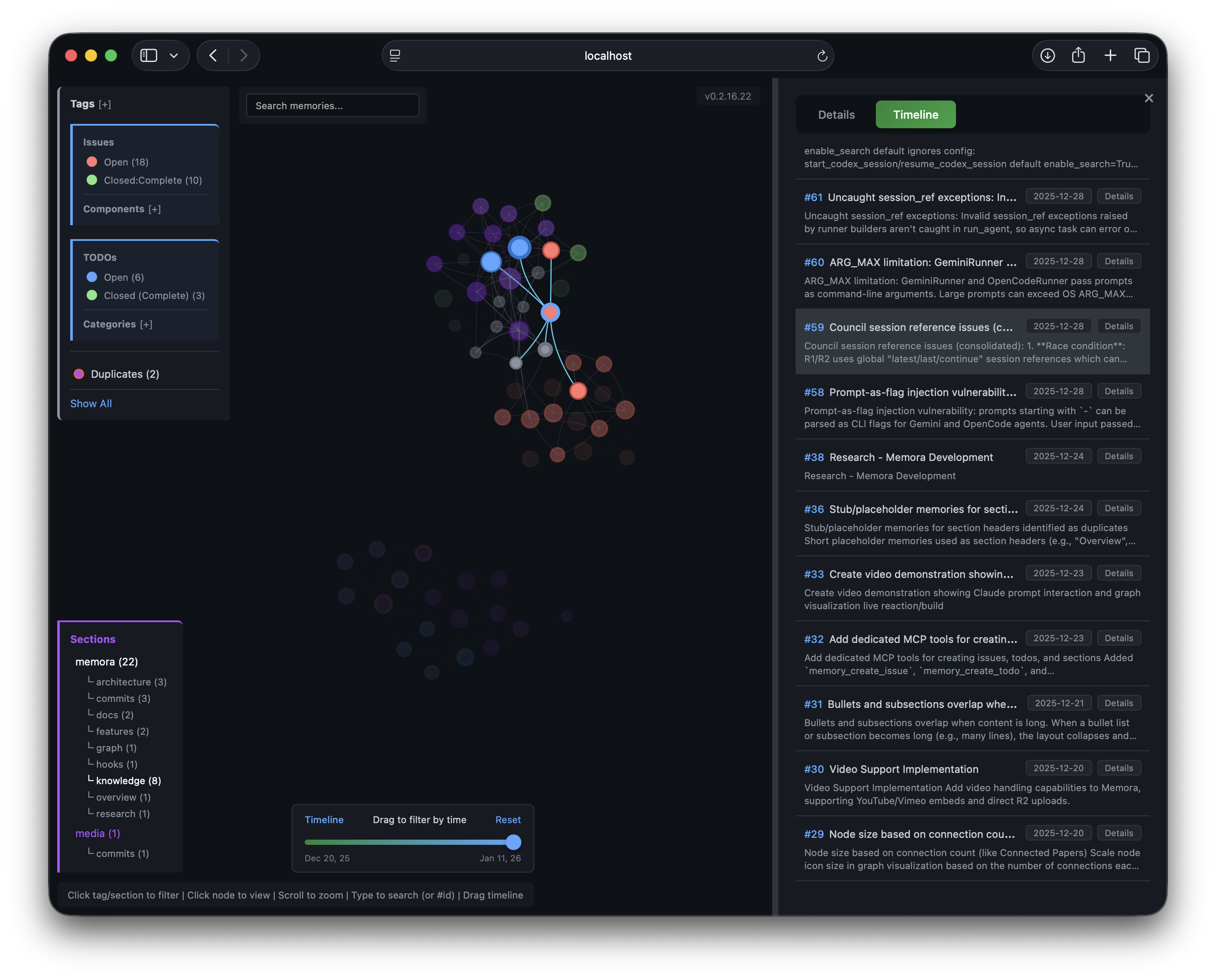 Timeline Panel
Access locally:
http://localhost:8765/graph
Remote access via SSH:
ssh -L 8765:localhost:8765 user@remote
# Then open http://localhost:8765/graph in your browser
Configuration:
{
  "env": {
    "MEMORA_GRAPH_PORT": "8765"
  }
}
To disable: add "--no-graph" to args in your MCP config.
[Memory #ID] referencesNode size reflects connection count.
Cloud Graph (Recommended for D1)
When using Cloudflare D1 as your database, the graph visualization is hosted on Cloudflare Pages - no local server needed.
Benefits:
?db= parameterSetup:
Create D1 database:
npx wrangler d1 create memora-graph
npx wrangler d1 execute memora-graph --file=memora-graph/schema.sql
Deploy Pages:
cd memora-graph
npx wrangler pages deploy ./public --project-name=memora-graph
Configure bindings in Cloudflare Dashboard:
DB_MEMORA → your databaseR2_MEMORA → your bucket (for images)Configure MCP with D1 URI:
{
  "env": {
    "MEMORA_STORAGE_URI": "d1:///",
    "CLOUDFLARE_API_TOKEN": ""
  }
}
Access: https://memora-graph.pages.dev
Secure with Zero Trust:
memora-graph.pages.devSee memora-graph/ for detailed setup and multi-database configuration.
Chat with Memories
Ask questions about your knowledge base directly from the graph UI. The chat panel uses RAG (Retrieval-Augmented Generation) to search relevant memories and stream LLM responses.
[Memory #ID] references that focus the graph nodeConfigure the chat model:
| Backend | Variable | Default |
|---|---|---|
| Local server | CHAT_MODEL env var | Falls back to MEMORA_LLM_MODEL |
| Cloudflare Pages | CHAT_MODEL in wrangler.toml | deepseek/deepseek-chat |
Requires an OpenAI-compatible API (OPENAI_API_KEY + OPENAI_BASE_URL for local, OPENROUTER_API_KEY secret for Cloudflare).
LLM Deduplication
Find and merge duplicate memories using AI-powered semantic comparison:
# Find potential duplicates (uses cross-refs + optional LLM analysis)
memory_find_duplicates(min_similarity=0.7, max_similarity=0.95, limit=10, use_llm=True)

# Merge duplicates (append, prepend, or replace strategies)
memory_merge(source_id=123, target_id=456, merge_strategy="append")
LLM Comparison analyzes memory pairs and returns:
verdict: "duplicate", "similar", or "different"confidence: 0.0-1.0 scorereasoning: Brief explanationsuggested_action: "merge", "keep_both", or "review"Works with any OpenAI-compatible API (OpenAI, OpenRouter, Azure, etc.) via OPENAI_BASE_URL.
Memory Automation Tools
Structured tools for common memory types:
# Create a TODO with status and priority
memory_create_todo(content="Implement feature X", status="open", priority="high", category="backend")

# Create an issue with severity
memory_create_issue(content="Bug in login flow", status="open", severity="major", component="auth")

# Create a section placeholder (hidden from graph)
memory_create_section(content="Architecture", section="docs", subsection="api")
Memory Insights
Analyze stored memories and surface actionable insights:
# Full analysis with LLM-powered pattern detection
memory_insights(period="7d", include_llm_analysis=True)

# Quick summary without LLM (faster, no API key needed)
memory_insights(period="1m", include_llm_analysis=False)
Returns:
MEMORA_STALE_DAYS, default 14)OPENAI_API_KEY)Memory Linking
Manage relationships between memories:
# Create typed edges between memories
memory_link(from_id=1, to_id=2, edge_type="implements", bidirectional=True)

# Edge types: references, implements, supersedes, extends, contradicts, related_to

# Remove links
memory_unlink(from_id=1, to_id=2)

# Boost memory importance for ranking
memory_boost(memory_id=42, boost_amount=0.5)

# Detect clusters of related memories
memory_clusters(min_cluster_size=2, min_score=0.3)
Knowledge Graph Export (Optional)
For offline viewing, export memories as a static HTML file:
memory_export_graph(output_path="~/memories_graph.html", min_score=0.25)
This is optional - the Live Graph Server provides the same visualization with real-time updates.
Neovim Integration
Browse memories directly in Neovim with Telescope. Copy the plugin to your config:
# For kickstart.nvim / lazy.nvim
cp nvim/memora.lua ~/.config/nvim/lua/kickstart/plugins/
Usage: Press sm to open the memory browser with fuzzy search and preview.
Requires: telescope.nvim, plenary.nvim, and memora installed in your Python environment.
Best experience: Claude Code
/plugin marketplace add agentic-mcp-tools/memoraThen /plugin menu → select skill → restart. Use /skill-name:init for first-time setup.
Other platforms
Install via CLI
npx mdskills install agentic-mcp-tools/memoraOptional: local embeddings (offline, ~2GB for PyTorch) is a free, open-source AI agent skill. Persistent memory and knowledge management. Use at session start to load context, when the user asks about past work or stored knowledge, and when saving important information for future sessions.
Install Optional: local embeddings (offline, ~2GB for PyTorch) with a single command:
npx mdskills install agentic-mcp-tools/memoraThis downloads the skill files into your project and your AI agent picks them up automatically.
Optional: local embeddings (offline, ~2GB for PyTorch) works with Claude Code, Claude Desktop, Cursor, Vscode Copilot, Windsurf, Continue Dev, Codex, Gemini Cli, Amp, Roo Code, Goose, Opencode, Trae, Qodo, Command Code. Skills use the open SKILL.md format which is compatible with any AI coding agent that reads markdown instructions.
