
MCP Toolbox for Databases is an open source MCP server for databases. It enables you to develop tools easier, faster, and more securely by handling the complexities such as connection pooling, authentication, and more. This README provides a brief overview. For comprehensive details, see the full documentation. - Why Toolbox? - General Architecture - Getting Started - Installing the server - Runni
npx mdskills install googleapis/genai-toolboxRelated
@googleapis? Sign in with GitHub to claim this listing.Well-documented MCP server for database access with multiple SDKs and strong architecture
Note:
MCP Toolbox for Databases is currently in beta, and may see breaking changes until the first stable release (v1.0).
MCP Toolbox for Databases is an open source MCP server for databases. It enables you to develop tools easier, faster, and more securely by handling the complexities such as connection pooling, authentication, and more.
This README provides a brief overview. For comprehensive details, see the full documentation.
Note:
This solution was originally named “Gen AI Toolbox for Databases” as its initial development predated MCP, but was renamed to align with recently added MCP compatibility.
Toolbox helps you build Gen AI tools that let your agents access data in your database. Toolbox provides:
⚡ Supercharge Your Workflow with an AI Database Assistant ⚡
Stop context-switching and let your AI assistant become a true co-developer. By connecting your IDE to your databases with MCP Toolbox, you can delegate complex and time-consuming database tasks, allowing you to build faster and focus on what matters. This isn't just about code completion; it's about giving your AI the context it needs to handle the entire development lifecycle.
Here’s how it will save you time:
Learn how to connect your AI tools (IDEs) to Toolbox using MCP.
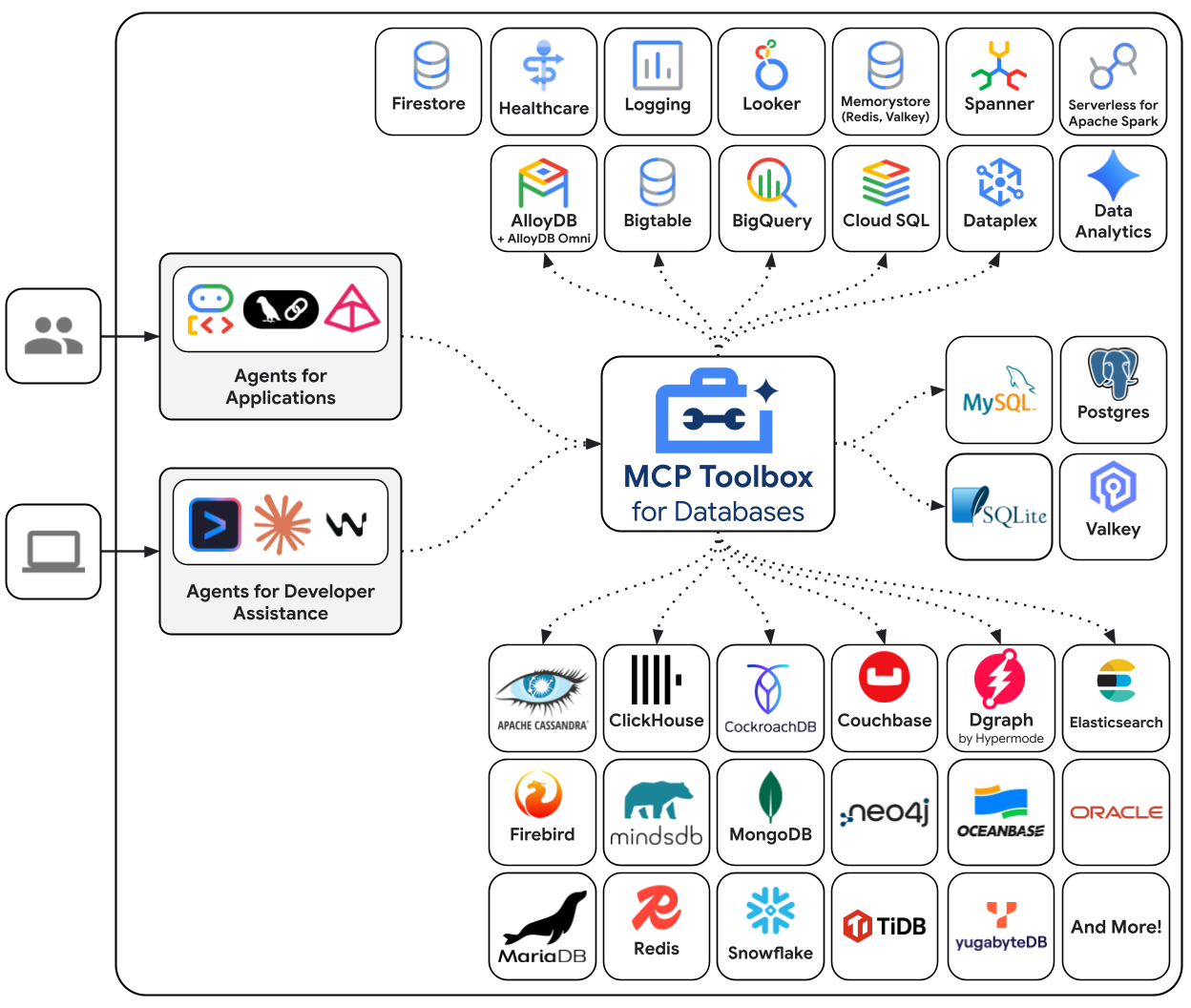
Toolbox sits between your application's orchestration framework and your database, providing a control plane that is used to modify, distribute, or invoke tools. It simplifies the management of your tools by providing you with a centralized location to store and update tools, allowing you to share tools between agents and applications and update those tools without necessarily redeploying your application.
You can run Toolbox directly with a configuration file:
npx @toolbox-sdk/server --tools-file tools.yaml
This runs the latest version of the toolbox server with your configuration file.
Note:
This method should only be used for non-production use cases such as experimentation. For any production use-cases, please consider Installing the server and then running it.
For the latest version, check the releases page and use the following instructions for your OS and CPU architecture.
Binary
To install Toolbox as a binary:
Linux (AMD64)
To install Toolbox as a binary on Linux (AMD64):
# see releases page for other versions
export VERSION=0.27.0
curl -L -o toolbox https://storage.googleapis.com/genai-toolbox/v$VERSION/linux/amd64/toolbox
chmod +x toolbox
macOS (Apple Silicon)
To install Toolbox as a binary on macOS (Apple Silicon):
# see releases page for other versions
export VERSION=0.27.0
curl -L -o toolbox https://storage.googleapis.com/genai-toolbox/v$VERSION/darwin/arm64/toolbox
chmod +x toolbox
macOS (Intel)
To install Toolbox as a binary on macOS (Intel):
# see releases page for other versions
export VERSION=0.27.0
curl -L -o toolbox https://storage.googleapis.com/genai-toolbox/v$VERSION/darwin/amd64/toolbox
chmod +x toolbox
Windows (Command Prompt)
To install Toolbox as a binary on Windows (Command Prompt):
:: see releases page for other versions
set VERSION=0.27.0
curl -o toolbox.exe "https://storage.googleapis.com/genai-toolbox/v%VERSION%/windows/amd64/toolbox.exe"
Windows (PowerShell)
To install Toolbox as a binary on Windows (PowerShell):
# see releases page for other versions
$VERSION = "0.27.0"
curl.exe -o toolbox.exe "https://storage.googleapis.com/genai-toolbox/v$VERSION/windows/amd64/toolbox.exe"
Container image You can also install Toolbox as a container:
# see releases page for other versions
export VERSION=0.27.0
docker pull us-central1-docker.pkg.dev/database-toolbox/toolbox/toolbox:$VERSION
Homebrew
To install Toolbox using Homebrew on macOS or Linux:
brew install mcp-toolbox
Compile from source
To install from source, ensure you have the latest version of Go installed, and then run the following command:
go install github.com/googleapis/genai-toolbox@v0.27.0
Gemini CLI Extensions
To install Gemini CLI Extensions for MCP Toolbox, run the following command:
gemini extensions install https://github.com/gemini-cli-extensions/mcp-toolbox
Configure a tools.yaml to define your tools, and then
execute toolbox to start the server:
Binary
To run Toolbox from binary:
./toolbox --tools-file "tools.yaml"
ⓘ Note
Toolbox enables dynamic reloading by default. To disable, use the--disable-reloadflag.
Container image
To run the server after pulling the container image:
export VERSION=0.24.0 # Use the version you pulled
docker run -p 5000:5000 \
-v $(pwd)/tools.yaml:/app/tools.yaml \
us-central1-docker.pkg.dev/database-toolbox/toolbox/toolbox:$VERSION \
--tools-file "/app/tools.yaml"
ⓘ Note
The-vflag mounts your localtools.yamlinto the container, and-pmaps the container's port5000to your host's port5000.
Source
To run the server directly from source, navigate to the project root directory and run:
go run .
ⓘ Note
This command runs the project from source, and is more suitable for development and testing. It does not compile a binary into your$GOPATH. If you want to compile a binary instead, refer the Developer Documentation.
Homebrew
If you installed Toolbox using Homebrew, the toolbox
binary is available in your system path. You can start the server with the same
command:
toolbox --tools-file "tools.yaml"
NPM
To run Toolbox directly without manually downloading the binary (requires Node.js):
npx @toolbox-sdk/server --tools-file tools.yaml
Gemini CLI
Interact with your custom tools using natural language. Check gemini-cli-extensions/mcp-toolbox for more information.
You can use toolbox help for a full list of flags! To stop the server, send a
terminate signal (ctrl+c on most platforms).
For more detailed documentation on deploying to different environments, check out the resources in the How-to section
Once your server is up and running, you can load the tools into your application. See below the list of Client SDKs for using various frameworks:
Python (Github)
Core
Install Toolbox Core SDK:
pip install toolbox-core
Load tools:
from toolbox_core import ToolboxClient

# update the url to point to your server
async with ToolboxClient("http://127.0.0.1:5000") as client:

    # these tools can be passed to your application!
    tools = await client.load_toolset("toolset_name")
For more detailed instructions on using the Toolbox Core SDK, see the project's README.
LangChain / LangGraph
Install Toolbox LangChain SDK:
pip install toolbox-langchain
Load tools:
from toolbox_langchain import ToolboxClient

# update the url to point to your server
async with ToolboxClient("http://127.0.0.1:5000") as client:

    # these tools can be passed to your application!
    tools = client.load_toolset()
For more detailed instructions on using the Toolbox LangChain SDK, see the project's README.
LlamaIndex
Install Toolbox Llamaindex SDK:
pip install toolbox-llamaindex
Load tools:
from toolbox_llamaindex import ToolboxClient

# update the url to point to your server
async with ToolboxClient("http://127.0.0.1:5000") as client:

    # these tools can be passed to your application!
    tools = client.load_toolset()
For more detailed instructions on using the Toolbox Llamaindex SDK, see the project's README.
Javascript/Typescript (Github)
Core
Install Toolbox Core SDK:
npm install @toolbox-sdk/core
Load tools:
import { ToolboxClient } from '@toolbox-sdk/core';

// update the url to point to your server
const URL = 'http://127.0.0.1:5000';
let client = new ToolboxClient(URL);

// these tools can be passed to your application!
const tools = await client.loadToolset('toolsetName');
For more detailed instructions on using the Toolbox Core SDK, see the project's README.
LangChain / LangGraph
Install Toolbox Core SDK:
npm install @toolbox-sdk/core
Load tools:
import { ToolboxClient } from '@toolbox-sdk/core';

// update the url to point to your server
const URL = 'http://127.0.0.1:5000';
let client = new ToolboxClient(URL);

// these tools can be passed to your application!
const toolboxTools = await client.loadToolset('toolsetName');

// Define the basics of the tool: name, description, schema and core logic
const getTool = (toolboxTool) => tool(currTool, {
    name: toolboxTool.getName(),
    description: toolboxTool.getDescription(),
    schema: toolboxTool.getParamSchema()
});

// Use these tools in your Langchain/Langraph applications
const tools = toolboxTools.map(getTool);
Genkit
Install Toolbox Core SDK:
npm install @toolbox-sdk/core
Load tools:
import { ToolboxClient } from '@toolbox-sdk/core';
import { genkit } from 'genkit';

// Initialise genkit
const ai = genkit({
    plugins: [
        googleAI({
            apiKey: process.env.GEMINI_API_KEY || process.env.GOOGLE_API_KEY
        })
    ],
    model: googleAI.model('gemini-2.0-flash'),
});

// update the url to point to your server
const URL = 'http://127.0.0.1:5000';
let client = new ToolboxClient(URL);

// these tools can be passed to your application!
const toolboxTools = await client.loadToolset('toolsetName');

// Define the basics of the tool: name, description, schema and core logic
const getTool = (toolboxTool) => ai.defineTool({
    name: toolboxTool.getName(),
    description: toolboxTool.getDescription(),
    schema: toolboxTool.getParamSchema()
}, toolboxTool)

// Use these tools in your Genkit applications
const tools = toolboxTools.map(getTool);
ADK
Install Toolbox ADK SDK:
npm install @toolbox-sdk/adk
Load tools:
import { ToolboxClient } from '@toolbox-sdk/adk';

// update the url to point to your server
const URL = 'http://127.0.0.1:5000';
let client = new ToolboxClient(URL);

// these tools can be passed to your application!
const tools = await client.loadToolset('toolsetName');
For more detailed instructions on using the Toolbox ADK SDK, see the project's README.
Go (Github)
Core
Install Toolbox Go SDK:
go get github.com/googleapis/mcp-toolbox-sdk-go
Load tools:
package main

import (
  "github.com/googleapis/mcp-toolbox-sdk-go/core"
  "context"
)

func main() {
  // Make sure to add the error checks
  // update the url to point to your server
  URL := "http://127.0.0.1:5000";
  ctx := context.Background()

  client, err := core.NewToolboxClient(URL)

  // Framework agnostic tools
  tools, err := client.LoadToolset("toolsetName", ctx)
}
For more detailed instructions on using the Toolbox Go SDK, see the project's README.
LangChain Go
Install Toolbox Go SDK:
go get github.com/googleapis/mcp-toolbox-sdk-go
Load tools:
package main
import (
"context"
"encoding/json"
"github.com/googleapis/mcp-toolbox-sdk-go/core"
"github.com/tmc/langchaingo/llms"
)
func main() {
// Make sure to add the error checks
// update the url to point to your server
URL := "http://127.0.0.1:5000"
ctx := context.Background()
client, err := core.NewToolboxClient(URL)
// Framework agnostic tool
tool, err := client.LoadTool("toolName", ctx)
// Fetch the tool's input schema
inputschema, err := tool.InputSchema()
var paramsSchema map[string]any
_ = json.Unmarshal(inputschema, ¶msSchema)
// Use this tool with LangChainGo
langChainTool := llms.Tool{
Type: "function",
Function: &llms.FunctionDefinition{
Name: tool.Name(),
Description: tool.Description(),
Parameters: paramsSchema,
},
}
}
Genkit
Install Toolbox Go SDK:
go get github.com/googleapis/mcp-toolbox-sdk-go
Load tools:
package main
import (
  "context"
  "log"

  "github.com/firebase/genkit/go/genkit"
  "github.com/googleapis/mcp-toolbox-sdk-go/core"
  "github.com/googleapis/mcp-toolbox-sdk-go/tbgenkit"
)

func main() {
  // Make sure to add the error checks
  // Update the url to point to your server
  URL := "http://127.0.0.1:5000"
  ctx := context.Background()
  g := genkit.Init(ctx)

  client, err := core.NewToolboxClient(URL)

  // Framework agnostic tool
  tool, err := client.LoadTool("toolName", ctx)

  // Convert the tool using the tbgenkit package
  // Use this tool with Genkit Go
  genkitTool, err := tbgenkit.ToGenkitTool(tool, g)
  if err != nil {
    log.Fatalf("Failed to convert tool: %v\n", err)
  }
  log.Printf("Successfully converted tool: %s", genkitTool.Name())
}
Go GenAI
Install Toolbox Go SDK:
go get github.com/googleapis/mcp-toolbox-sdk-go
Load tools:
package main

import (
  "context"
  "encoding/json"

  "github.com/googleapis/mcp-toolbox-sdk-go/core"
  "google.golang.org/genai"
)

func main() {
  // Make sure to add the error checks
  // Update the url to point to your server
  URL := "http://127.0.0.1:5000"
  ctx := context.Background()

  client, err := core.NewToolboxClient(URL)

  // Framework agnostic tool
  tool, err := client.LoadTool("toolName", ctx)

  // Fetch the tool's input schema
  inputschema, err := tool.InputSchema()

  var schema *genai.Schema
  _ = json.Unmarshal(inputschema, &schema)

  funcDeclaration := &genai.FunctionDeclaration{
    Name:        tool.Name(),
    Description: tool.Description(),
    Parameters:  schema,
  }

  // Use this tool with Go GenAI
  genAITool := &genai.Tool{
    FunctionDeclarations: []*genai.FunctionDeclaration{funcDeclaration},
  }
}
OpenAI Go
Install Toolbox Go SDK:
go get github.com/googleapis/mcp-toolbox-sdk-go
Load tools:
package main
import (
"context"
"encoding/json"
"github.com/googleapis/mcp-toolbox-sdk-go/core"
openai "github.com/openai/openai-go"
)
func main() {
// Make sure to add the error checks
// Update the url to point to your server
URL := "http://127.0.0.1:5000"
ctx := context.Background()
client, err := core.NewToolboxClient(URL)
// Framework agnostic tool
tool, err := client.LoadTool("toolName", ctx)
// Fetch the tool's input schema
inputschema, err := tool.InputSchema()
var paramsSchema openai.FunctionParameters
_ = json.Unmarshal(inputschema, ¶msSchema)
// Use this tool with OpenAI Go
openAITool := openai.ChatCompletionToolParam{
Function: openai.FunctionDefinitionParam{
Name: tool.Name(),
Description: openai.String(tool.Description()),
Parameters: paramsSchema,
},
}
}
ADK Go
Install Toolbox Go SDK:
go get github.com/googleapis/mcp-toolbox-sdk-go
Load tools:
package main

import (
  "github.com/googleapis/mcp-toolbox-sdk-go/tbadk"
  "context"
)

func main() {
  // Make sure to add the error checks
  // Update the url to point to your server
  URL := "http://127.0.0.1:5000"
  ctx := context.Background()
  client, err := tbadk.NewToolboxClient(URL)
  if err != nil {
    return fmt.Sprintln("Could not start Toolbox Client", err)
  }

  // Use this tool with ADK Go
  tool, err := client.LoadTool("toolName", ctx)
  if err != nil {
    return fmt.Sprintln("Could not load Toolbox Tool", err)
  }
}
For more detailed instructions on using the Toolbox Go SDK, see the project's README.
Gemini CLI extensions provide tools to interact directly with your data sources from command line. Below is a list of Gemini CLI extensions that are built on top of Toolbox. They allow you to interact with your data sources through pre-defined or custom tools with natural language. Click into the link to see detailed instructions on their usage.
To use custom tools with Gemini CLI:
To use prebuilt tools with Gemini CLI:
The primary way to configure Toolbox is through the tools.yaml file. If you
have multiple files, you can tell toolbox which to load with the --tools-file tools.yaml flag.
You can find more detailed reference documentation to all resource types in the Resources.
The sources section of your tools.yaml defines what data sources your
Toolbox should have access to. Most tools will have at least one source to
execute against.
kind: sources
name: my-pg-source
type: postgres
host: 127.0.0.1
port: 5432
database: toolbox_db
user: toolbox_user
password: my-password
For more details on configuring different types of sources, see the Sources.
The tools section of a tools.yaml define the actions an agent can take: what
type of tool it is, which source(s) it affects, what parameters it uses, etc.
kind: tools
name: search-hotels-by-name
type: postgres-sql
source: my-pg-source
description: Search for hotels based on name.
parameters:
  - name: name
    type: string
    description: The name of the hotel.
statement: SELECT * FROM hotels WHERE name ILIKE '%' || $1 || '%';
For more details on configuring different types of tools, see the Tools.
The toolsets section of your tools.yaml allows you to define groups of tools
that you want to be able to load together. This can be useful for defining
different groups based on agent or application.
toolsets:
    my_first_toolset:
        - my_first_tool
        - my_second_tool
    my_second_toolset:
        - my_second_tool
        - my_third_tool
You can load toolsets by name:
# This will load all tools
all_tools = client.load_toolset()

# This will only load the tools listed in 'my_second_toolset'
my_second_toolset = client.load_toolset("my_second_toolset")
The prompts section of a tools.yaml defines prompts that can be used for
interactions with LLMs.
prompts:
  code_review:
    description: "Asks the LLM to analyze code quality and suggest improvements."
    messages:
      - content: "Please review the following code for quality, correctness, and potential improvements: \n\n{{.code}}"
    arguments:
      - name: "code"
        description: "The code to review"
For more details on configuring prompts, see the Prompts.
This project uses semantic versioning (MAJOR.MINOR.PATCH).
Since the project is in a pre-release stage (version 0.x.y), we follow the
standard conventions for initial development:
While the major version is 0, the public API should be considered unstable.
The version will be incremented as follows:
0.MINOR.PATCH: The MINOR version is incremented when we add
new functionality or make breaking, incompatible API changes.0.MINOR.PATCH: The PATCH version is incremented for
backward-compatible bug fixes.Once the project reaches a stable 1.0.0 release, the version number
MAJOR.MINOR.PATCH will follow the more common convention:
MAJOR: Incremented for incompatible API changes.MINOR: Incremented for new, backward-compatible functionality.PATCH: Incremented for backward-compatible bug fixes.The public API that this applies to is the CLI associated with Toolbox, the
interactions with official SDKs, and the definitions in the tools.yaml file.
Contributions are welcome. Please, see the CONTRIBUTING to get started.
Please note that this project is released with a Contributor Code of Conduct. By participating in this project you agree to abide by its terms. See Contributor Code of Conduct for more information.
Join our discord community to connect with our developers!
Install via CLI
npx mdskills install googleapis/genai-toolboxMCP Toolbox for Databases is a free, open-source AI agent skill. MCP Toolbox for Databases is an open source MCP server for databases. It enables you to develop tools easier, faster, and more securely by handling the complexities such as connection pooling, authentication, and more. This README provides a brief overview. For comprehensive details, see the full documentation. - Why Toolbox? - General Architecture - Getting Started - Installing the server - Runni
Install MCP Toolbox for Databases with a single command:
npx mdskills install googleapis/genai-toolboxThis downloads the skill files into your project and your AI agent picks them up automatically.
MCP Toolbox for Databases works with Claude Code, Claude Desktop, Cursor, Vscode Copilot, Windsurf, Continue Dev, Codex, Gemini Cli, Amp, Roo Code, Goose, Opencode, Trae, Qodo, Command Code. Skills use the open SKILL.md format which is compatible with any AI coding agent that reads markdown instructions.