
Comprehensive interactive testing of all Memory MCP features
npx mdskills install michael-denyer/test-memoryRelated
@michael-denyer? Sign in with GitHub to claim this listing.Exhaustive guided test suite covering all memory operations with detailed verification steps
Stop re-explaining your project every session.
Memory MCP learns what matters and keeps it ready — instant recall for the stuff you use most, semantic search for everything else.
Every new chat starts from scratch. You explain your architecture again. You paste the same patterns again. Your context window bloats with repetition.
Other memory solutions help, but they still require tool calls for every lookup — adding latency and eating into Claude's thinking budget.
Memory MCP fixes this with a two-tier architecture:
The system learns what you use and promotes it automatically. Your most valuable knowledge becomes instantly available. No manual curation required.
| 😤 Without Memory MCP | 🎯 With Memory MCP |
|---|---|
| "Let me explain our architecture again..." | Project facts persist and isolate per repo |
| Copy-paste the same patterns every session | Patterns auto-promoted to instant access |
| 500k+ token context windows | Hot cache keeps it lean (~20 items) |
| Tool call latency on every memory lookup | Hot cache: 0ms — already in context |
| Stale information lingers forever | Trust scoring demotes outdated facts |
| Flat list of disconnected facts | Knowledge graph connects related concepts |
# Install package
uv tool install hot-memory-mcp   # or: pip install hot-memory-mcp

# Add plugin (recommended)
claude plugins add michael-denyer/memory-mcp
The plugin gives you auto-configured hooks, slash commands, and the Memory Analyst agent. MLX is auto-detected on Apple Silicon.
Manual config (no plugin)
Add to ~/.claude.json:
{
  "mcpServers": {
    "memory": {
      "command": "memory-mcp"
    }
  }
}
See Reference for full configuration options.
Restart Claude Code. The hot cache auto-populates from your project docs.
First run: Embedding model (~90MB) downloads automatically. Takes 30-60 seconds once.
flowchart LR
    subgraph LLM["Claude"]
        REQ((Request))
    end

    subgraph Hot["HOT CACHE · 0ms"]
        HC[Session context]
        PM[(Promoted memories)]
    end

    subgraph Cold["COLD STORAGE · ~50ms"]
        VS[(Vector search)]
        KG[(Knowledge graph)]
    end

    REQ -->|"auto-injected"| HC
    HC -.->|"draws from"| PM
    REQ -->|"recall()"| VS
    VS |"related"| KG
The hot cache (~10 items) is injected into every request — it combines recent recalls, predicted next memories, and top promoted items. Promoted memories (~20 items) is the backing store of frequently-used memories. Memories used 3+ times auto-promote; unused ones demote after 14 days.
Most memory systems make you pay a tool-call tax on every lookup. Memory MCP's hot cache bypasses this entirely — your most-used knowledge is already in context when Claude starts thinking.
| Memory MCP | Generic Memory Servers | |
|---|---|---|
| Hot cache | Auto-injected at 0ms | Every lookup = tool call |
| Self-organizing | Learns and promotes automatically | Manual curation required |
| Project-aware | Auto-isolates by git repo | One big pile of memories |
| Knowledge graph | Multi-hop recall across concepts | Flat list of facts |
| Pattern mining | Learns from Claude's outputs | Not available |
| Trust scoring | Outdated info decays and sinks | All memories equal |
| Setup | One command, local SQLite | Often needs cloud setup |
The Engram Insight: Human memory doesn't search — frequently-used patterns are already there. That's what hot cache does for Claude.
| Slash Command | Tool | Description |
|---|---|---|
/memory-mcp:remember | remember | Store a memory with semantic embedding |
/memory-mcp:recall | recall | Search memories by meaning |
/memory-mcp:hot-cache | promote / demote | Manage promoted memories |
/memory-mcp:stats | memory_stats | Show statistics |
/memory-mcp:bootstrap | bootstrap_project | Seed from project docs |
| — | link_memories | Knowledge graph connections |
See Reference for all 14 slash commands and full tool API.
memory-mcp-cli dashboard # Opens at http://localhost:8765
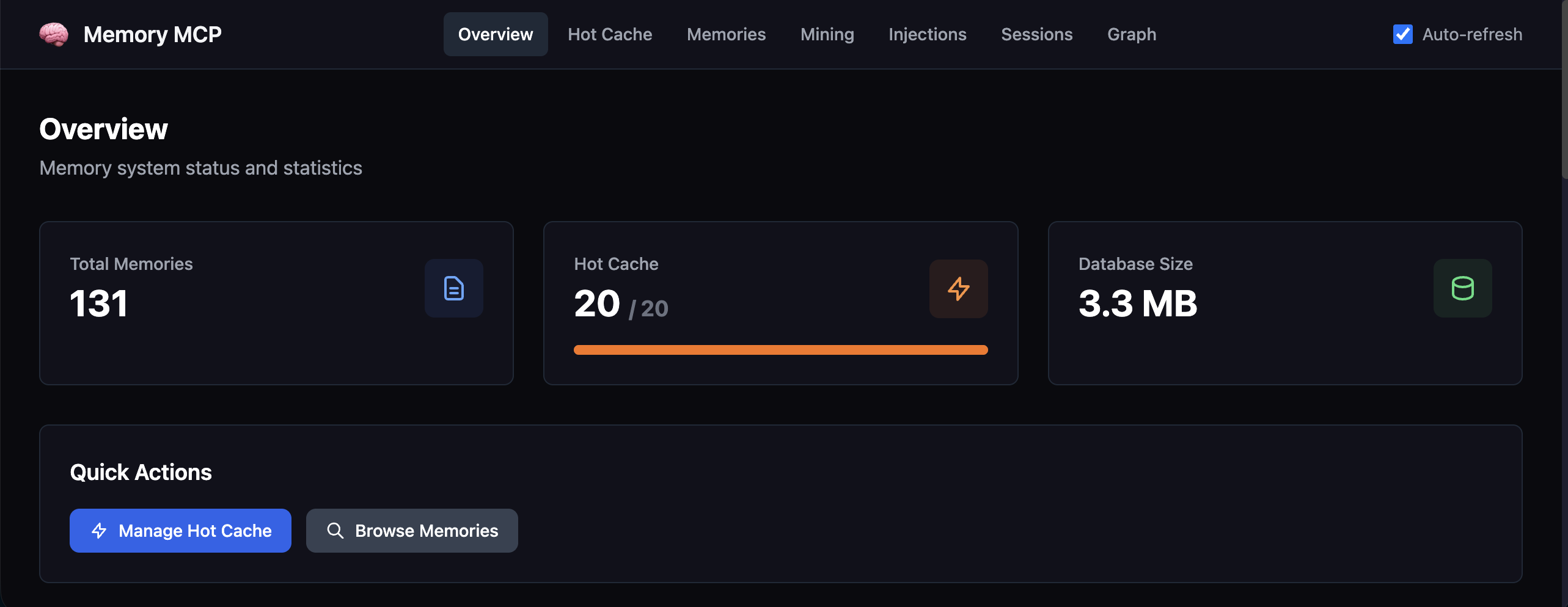
Browse memories, hot cache, mining candidates, sessions, and knowledge graph.
Memory MCP is designed to run as three complementary components:
| Component | Purpose |
|---|---|
| Claude Code Plugin | Hooks, slash commands, and Memory Analyst agent for seamless integration |
| MCP Server | Core memory tools available to Claude via Model Context Protocol |
| Dashboard | Web UI to browse, manage, and debug your memory database |
The plugin is recommended for most users — it auto-configures the MCP server and adds productivity features. Run the dashboard alongside when you want visibility into what's being stored.
| Document | Description |
|---|---|
| Reference | Full API, CLI, configuration, MCP resources |
| Troubleshooting | Common issues and solutions |
MIT
Best experience: Claude Code
/plugin marketplace add michael-denyer/test-memoryThen /plugin menu → select skill → restart. Use /skill-name:init for first-time setup.
Other platforms
Install via CLI
npx mdskills install michael-denyer/test-memoryTest Memory is a free, open-source AI agent skill. Comprehensive interactive testing of all Memory MCP features
Install Test Memory with a single command:
npx mdskills install michael-denyer/test-memoryThis downloads the skill files into your project and your AI agent picks them up automatically.
Test Memory works with Claude Code, Claude Desktop, Cursor, Vscode Copilot, Windsurf, Continue Dev, Gemini Cli, Amp, Roo Code, Goose. Skills use the open SKILL.md format which is compatible with any AI coding agent that reads markdown instructions.