
The Quickchat AI MCP (Model Context Protocol) server allows you to let anyone plug in your Quickchat AI Agent into their favourite AI app such as Claude Desktop, Cursor, VS Code, Windsurf and more. 1. Create a Quickchat AI account and start a 7-day trial of any plan. 2. Set up your AI's Knowledge Base, capabilities and settings. 3. Go to the MCP page to activate your MCP. Give it Name, Description
npx mdskills install incentivai/quickchat-ai-mcpRelated
@incentivai? Sign in with GitHub to claim this listing.Well-documented MCP server that bridges Quickchat AI agents into MCP-compatible apps with clear setup guides.
The Quickchat AI MCP (Model Context Protocol) server allows you to let anyone plug in your Quickchat AI Agent into their favourite AI app such as Claude Desktop, Cursor, VS Code, Windsurf and more.
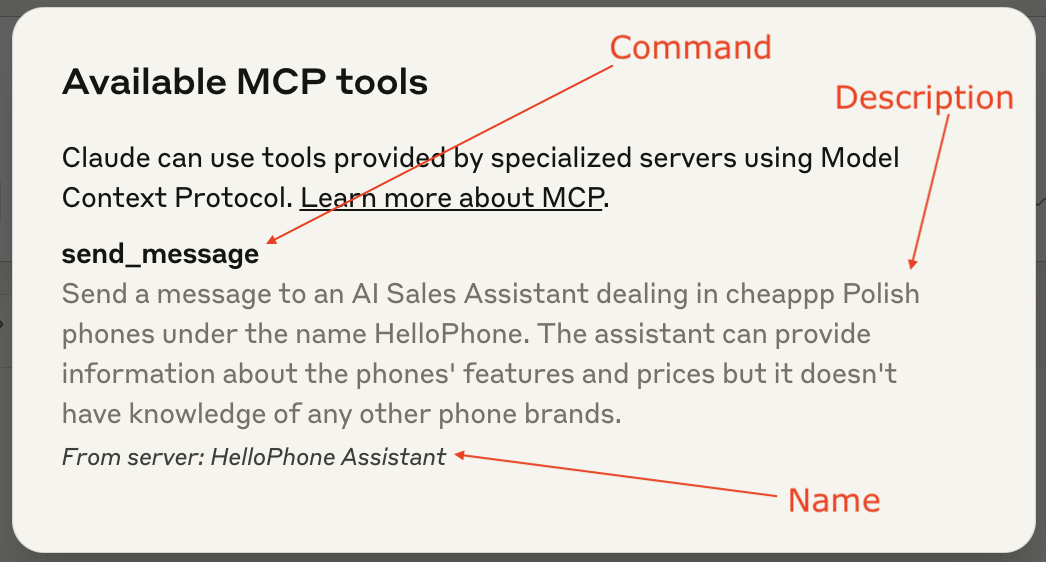
Claude tool anatomy
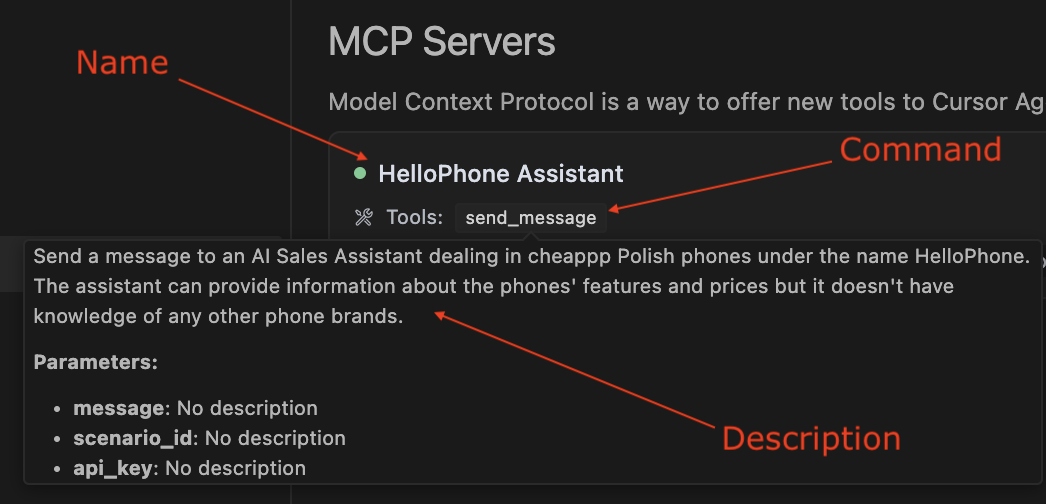
Cursor tool anatomy
Install uv using:
curl -LsSf https://astral.sh/uv/install.sh | sh
or read more here.
Go to Settings > Developer > Edit Config. Open the claude_desktop_config.json file in a text editor. If you're just starting out, the file is going to look like this:
{
  "mcpServers": {}
}
This is where you can define all the MCPs your Claude Desktop has access to. Here is how you add your Quickchat AI MCP:
{
  "mcpServers": {
    "": {
      "command": "uvx",
      "args": ["quickchat-ai-mcp"],
      "env": {
        "SCENARIO_ID": "",
        "API_KEY": ""
      }
    }
  }
}
Go to the Quickchat AI app > MCP > Integration to find the above snippet with the values of MCP Name, SCENARIO_ID and API_KEY filled out.
Go to Settings > Cursor Settings > MCP > Add new global MCP server and include the Quickchat AI MCP snippet:
{
  "mcpServers": {
    "": {
      "command": "uvx",
      "args": ["quickchat-ai-mcp"],
      "env": {
        "SCENARIO_ID": "",
        "API_KEY": ""
      }
    }
  }
}
As before, you can find values for MCP Name, SCENARIO_ID and API_KEY at Quickchat AI app > MCP > Integration.
Other AI apps will most likely require the same configuration but the actual steps to include it in the App itself will be different. We will be expanding this README as we go along.
⛔️ Do not publish your Quickchat API key to your users!
Once you're ready to let other users connect your Quickchat AI MCP to their AI apps, share configuration snippet with them! However, you need to make sure they can use your Quickchat AI MCP without your Quickchat API key. Here is how to do that:
{
  "mcpServers": {
    "": {
      "command": "uvx",
      "args": ["quickchat-ai-mcp"],
      "env": {
        "SCENARIO_ID": ""
      }
    }
  }
}
uv run mcp dev src/__main__.py
Use the following JSON configuration:
{
  "mcpServers": {
    "": {
      "command": "uv",
      "args": [
        "run",
        "--with",
        "mcp[cli]",
        "--with",
        "requests",
        "mcp",
        "run",
        "/quickchat-ai-mcp/src/__main__.py"
      ],
      "env": {
        "SCENARIO_ID": "",
        "API_KEY": ""
      }
    }
  }
}
Make sure your code is properly formatted and all tests are passing:
ruff check --fix
ruff format
uv run pytest
Install via CLI
npx mdskills install incentivai/quickchat-ai-mcpQuickchat AI MCP server is a free, open-source AI agent skill. The Quickchat AI MCP (Model Context Protocol) server allows you to let anyone plug in your Quickchat AI Agent into their favourite AI app such as Claude Desktop, Cursor, VS Code, Windsurf and more. 1. Create a Quickchat AI account and start a 7-day trial of any plan. 2. Set up your AI's Knowledge Base, capabilities and settings. 3. Go to the MCP page to activate your MCP. Give it Name, Description
Install Quickchat AI MCP server with a single command:
npx mdskills install incentivai/quickchat-ai-mcpThis downloads the skill files into your project and your AI agent picks them up automatically.
Quickchat AI MCP server works with Claude Code, Claude Desktop, Cursor, Vscode Copilot, Windsurf, Continue Dev, Gemini Cli, Amp, Roo Code, Goose. Skills use the open SKILL.md format which is compatible with any AI coding agent that reads markdown instructions.