
59 skills that actually work. Built by a physician-researcher, tested on real publications. MedSci Skills is an end-to-end research tool for physician and medical-engineering researchers — design → scaffold → validate → publish — for the clinical manuscript and the medical-AI model behind it. Its moat is the compliance layer — 49 reporting guidelines and risk-of-bias tools, referenc
npx mdskills install Aperivue/medsci-skillsRelated
@Aperivue? Sign in with GitHub to claim this listing.1<div align="center">23# MedSci Skills45[English](README.md) | [简体中文](README.zh-CN.md)67**59 skills that actually work.** Built by a physician-researcher, tested on real publications.89*MedSci Skills is an end-to-end research tool for physician and medical-engineering researchers — design → scaffold → validate → publish — for the clinical manuscript and the medical-AI model behind it. Its moat is the compliance layer — 49 reporting guidelines and risk-of-bias tools, reference/citation verification, and deterministic integrity gates before peer review — now extended by a model-engineering lane that scaffolds reproducible, leakage-safe training repos and audits model validation. Clinical AI model research engineering is in scope; a general AI-scientist platform is not. It competes on clinical submission reliability, not skill count.*1011[](LICENSE)12[](https://github.com/Aperivue/medsci-skills/releases/latest)13[](https://github.com/Aperivue/medsci-skills/actions/workflows/validate.yml)1415[](https://www.npmjs.com/package/medsci-skills)16[](https://www.npmjs.com/package/medsci-skills)17[](https://youtu.be/MclQ_RIofpE)18[](https://github.com/Aperivue/medsci-skills/contribute)1920[](https://agentskills.io)21[](docs/host_compatibility.md)22[](docs/host_compatibility.md)23[](docs/host_compatibility.md)24[](docs/host_compatibility.md)2526[](https://doi.org/10.5281/zenodo.20155321)27[](https://arxiv.org/abs/2606.09500)28[](CITATION.cff)293031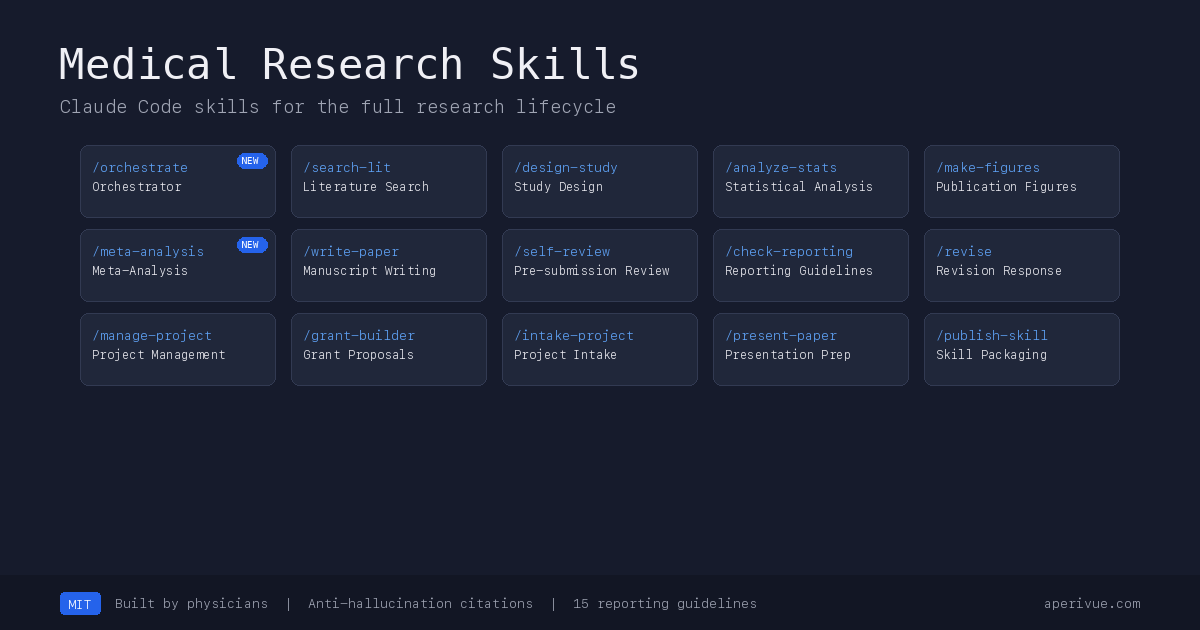3233*Topic Discovery → Literature Search → Full-Text Retrieval → Study Design → Sample Size → Protocol → De-identification → Data Cleaning → Statistics → Figures → Writing → Humanize → Compliance → Journal Selection → Peer Review → Revision → Presentation*3435**Created & maintained by [Yoojin Nam, MD](https://orcid.org/0000-0001-8565-1360)**36<br>37<sub>Department of Radiology and Research Institute of Radiology, University of Ulsan College of Medicine, Asan Medical Center, Seoul, Republic of Korea</sub>3839</div>40414243---4445## What is MedSci Skills?4647MedSci Skills is an open-source **Agent Skills** collection for **clinical48research — the manuscript and the medical-AI model alike** — designed to be driven49directly by AI coding agents (Claude Code, Codex, Cursor, and GitHub Copilot). It helps50physician-researchers and biomedical/medical-engineering investigators move from51literature search, study design, statistics, and figures to reporting-guideline52compliance, citation/reference auditing, numerical-consistency checks, and53response-to-reviewer workflows — combining agentic writing with **deterministic54integrity gates** for submission-grade biomedical research. As of **v5.0** it adds a55**model-engineering lane**: choose a paper-grounded architecture, scaffold a56reproducible, leakage-safe PyTorch training repo, and validate, document, and57evaluate a medical-imaging or LLM/MLLM model so the work reaches a paper — it58ships a minimal runnable default model for a forward-pass smoke test and59**integrates** MONAI / nnU-Net / timm / torchvision for production-grade models,60rather than reimplementing the ecosystem. Clinical AI model research61engineering is in scope; it is **not** a diagnostic tool, an autonomous author, or a62general AI-scientist platform, and every output requires human-expert verification.63New here? See the [3 workflows below](#start-here-3-workflows), the64[FAQ](docs/faq.md), the65[research connectors it calls](docs/connectors.md) (keyless public APIs — nothing to set66up in the common case), and the67[scope boundary](ROADMAP.md#not-planned--explicitly-out-of-scope).6869---7071## Quick Start7273**No terminal?** Use the classroom installer ZIP — download, unzip, double-click the installer, then restart your agent app (see [Installation](#installation)).7475**Have a terminal?** Fastest path — one command, nothing to clone:7677```bash78npx medsci-skills install # copies every skill into your agent's folder79```8081**Recommended (especially for clinicians):** add `--enable-update-notify` so Claude Code shows a one-line *"update available"* notice when a new version ships — otherwise you stay on the version you installed and are never told. (No terminal at all? The classroom installer below turns this on for you.)8283```bash84npx medsci-skills install --enable-update-notify # install + in-app update reminders85```8687**Have git?** Install every skill in three commands:8889```bash90git clone https://github.com/Aperivue/medsci-skills.git91mkdir -p ~/.claude/skills92cp -r medsci-skills/skills/* ~/.claude/skills/93```9495Restart Claude Code, then start with **`/orchestrate`** — it classifies your request and routes you to the right skill. Full install options (Codex, Cursor, individual skills) are in [Installation](#installation).9697### Install with `gh skill`9899MedSci Skills follows the [Agent Skills standard](https://agentskills.io), so GitHub CLI ≥ 2.90 can search, preview, and install any skill straight from this repo — no clone (a `gh` preview feature):100101```bash102gh skill search medsci # list the whole collection103gh skill preview Aperivue/medsci-skills check-reporting # read a skill before installing104gh skill install Aperivue/medsci-skills check-reporting # install just that one105gh skill install --all Aperivue/medsci-skills # or install every skill106```107108Search by a skill's own name (`check-reporting`, `verify-refs`, `meta-analysis`) or by `medsci` to list them all — both return this repo directly. A broad topic word like `systematic review` is shared by hundreds of skills across GitHub, so add `--owner Aperivue` to see only ours.109110### Install as a Claude Code plugin111112Prefer plugins? One line adds the marketplace; `/plugin` then lets you browse nine category plugins and enable the ones you want:113114```text115/plugin marketplace add Aperivue/medsci-skills116/plugin # browse nine category plugins; enable the ones you want117```118119| Plugin | Covers |120|--------|--------|121| `medsci-literature` | Literature search, full-text retrieval, Zotero sync, reference-integrity audits |122| `medsci-data` | Study design, variable operationalization, sample size, data cleaning, de-identification, codebooks, dataset versioning |123| `medsci-modeling` | Architecture selection, reproducible model-scaffold repos, model-validation audits, Model Card/Datasheet, model & LLM/MLLM evaluation |124| `medsci-analysis` | Statistics, figures, batch/cross-national/replication analysis, meta-analysis |125| `medsci-writing` | IMRAD & protocol drafting, AI-pattern removal, AI-search optimization, reviewer responses |126| `medsci-review` | Self-review, peer review, reporting-guideline compliance |127| `medsci-submission` | Submission packaging, journal selection, ICMJE/IRB form filling, grant proposals |128| `medsci-project` | Orchestration, project intake/management, gap & topic discovery, author strategy |129| `medsci-presentation` | Presentations/PPTX, PDF/document rendering, environment setup, skill publishing |130131Install a single category and invoke its skills under that namespace:132133```text134/plugin install medsci-analysis@medsci-skills135/medsci-analysis:analyze-stats136```137138All nine plugins share the same repository source, so this groups and enables skills by category — it is not a partial download. The marketplace tracks `main`, so a plugin's version is its git commit.139140**Want just one capability?** Two skills are also published as focused standalone repos (generated mirrors; this repo stays the source of truth), each installable on its own with `/plugin marketplace add Aperivue/<repo>`:141142- [`Aperivue/verify-refs`](https://github.com/Aperivue/verify-refs) — catch fabricated/mismatched citations (PubMed + CrossRef).143- [`Aperivue/check-reporting`](https://github.com/Aperivue/check-reporting) — audit a manuscript against the bundled EQUATOR reporting guidelines and risk-of-bias tools.144145---146147## Start here: 3 workflows148149New users don't need all the skills at once. Most work starts as one of three150workflows. Each runs through `/orchestrate` or by invoking the named skills in151order; all outputs require human-expert review.152153**Workflow A — Manuscript pre-submission audit.** *Use when* a manuscript is nearly154ready and you want it checked before a reviewer sees it. *Skills:* `/self-review` →155`/check-reporting` → `/verify-refs` → `/sync-submission`. *In:* your manuscript156(+ `refs.bib`, tables/figures). *Out:* anticipated reviewer comments, an item-by-item157reporting-guideline audit, a citation-integrity report, and a submission-package158drift check. *Safety:* it flags issues; you fix and verify them.159160**Workflow B — Data to manuscript package.** *Use when* you have a cleaned dataset161and need a full draft. *Skills:* `/clean-data` → `/analyze-stats` → `/make-figures` →162`/write-paper` → `/check-reporting` → `/find-journal`. *In:* a cleaned CSV/parquet163+ a research question. *Out:* reproducible analysis code, publication-ready figures,164an IMRaD draft, a reporting checklist, and a journal shortlist. *Safety:* statistics165and claims must be verified against your data; the toolkit never fabricates numbers166or references.167168**Workflow C — Systematic review / meta-analysis.** *Use when* you are running an169SR/MA. *Skills:* `/meta-analysis` (with `/search-lit`, `/make-figures`,170`/check-reporting`). *In:* a research question + search strategy. *Out:* PROSPERO-style171protocol scaffolding, screening/extraction structure, PRISMA-consistent counts and172diagram, pooled-estimate figures, and a manuscript draft. *Safety:* screening and173extraction decisions stay with the human review team.174175## Live Demos: Five Study Types, Five Full Pipelines176177Five public datasets. Five study types. Demos 1–3 each produce a complete manuscript, publication-ready figures, and a reporting-compliance audit; Demo 4 runs the medical-AI **model-engineering lane** end to end (scaffold → gates → training → evaluation → interpretability); Demo 5 takes that lane onto a GPU cluster and out to a **genuinely external cohort**, then reports where it broke.178179| Demo | Dataset | Study Type | Compliance |180|------|---------|------------|------------|181| [Demo 1: Wisconsin BC](demo/01_wisconsin_bc/) | `sklearn` built-in | Diagnostic accuracy | STARD 2015 |182| [Demo 2: BCG Vaccine](demo/02_metafor_bcg/) | `metafor::dat.bcg` (13 RCTs) | Meta-analysis | PRISMA 2020 |183| [Demo 3: NHANES Obesity](demo/03_nhanes_obesity/) | CDC NHANES 2017-18 | Epidemiology (survey) | STROBE |184| [Demo 4: PneumoniaMNIST CNN](demo/04_pneumoniamnist_cnn/) | `medmnist` (CC BY 4.0) | Medical-AI model engineering (CNN) | CLAIM / TRIPOD+AI |185| [Demo 5: MSD → AMOS spleen](demo/05_msd_amos_spleen/) | MSD Task09 + AMOS22 (CC BY 4.0) | 3-D segmentation, external validation + modality shift | CLAIM / Metrics Reloaded |186187### Demo 1: Diagnostic Accuracy — Wisconsin Breast Cancer188189```python190from sklearn.datasets import load_breast_cancer191data = load_breast_cancer() # 569 samples, zero download192```193194**Output from `orchestrate --e2e`** ([see full demo](demo/01_wisconsin_bc/)):195196<details>197<summary>Full output list — manuscript, figures, STARD flow, checklist (click to expand)</summary>198199| Output | Description |200|--------|-------------|201| [Manuscript](demo/01_wisconsin_bc/manuscript/manuscript.md) | IMRAD draft, ~1,800 words |202| [Title Page](demo/01_wisconsin_bc/manuscript/title_page.md) | STARD title page with key points |203| [DOCX](demo/01_wisconsin_bc/manuscript/manuscript_final.docx) | Submission-ready Word document |204| [ROC Curve](demo/01_wisconsin_bc/analysis/figures/roc_curve.png) | 3-model comparison with DeLong 95% CIs |205| [Confusion Matrices](demo/01_wisconsin_bc/analysis/figures/confusion_matrices.png) | Per-model confusion matrices at threshold 0.5 |206| [STARD Flow](demo/01_wisconsin_bc/figures/stard_flow.svg) | D2-generated STARD 2015 flow diagram |207| [Reporting Checklist](demo/01_wisconsin_bc/qc/reporting_checklist.md) | STARD 2015 — 60.9% compliance (14/23 applicable) |208| [Self-Review](demo/01_wisconsin_bc/qc/self_review.md) | Initial 82 (REVISE) → 88 (PASS) after 1 fix iteration; final 0 major / 1 minor |209| [Pipeline Log](demo/01_wisconsin_bc/qc/_pipeline_log.md) | 7-step E2E execution trace |210211</details>212213**Pipeline:** `analyze-stats` → `make-figures` → `write-paper` → AI pattern scan → `check-reporting` (STARD) → `self-review` → DOCX build → `present-paper`214215### Demo 2: Meta-Analysis — BCG Vaccine Efficacy216217```r218library(metafor)219data(dat.bcg) # 13 RCTs, 357,347 participants (Colditz et al. 1994)220```221222**Output from `orchestrate --e2e`** ([see full demo](demo/02_metafor_bcg/)):223224<details>225<summary>Full output list — manuscript, forest/funnel plots, PRISMA flow, checklist (click to expand)</summary>226227| Output | Description |228|--------|-------------|229| [Manuscript](demo/02_metafor_bcg/manuscript/manuscript.md) | Pooled RR = 0.489 (95% CI: 0.344–0.696), ~2,200 words |230| [Title Page](demo/02_metafor_bcg/manuscript/title_page.md) | PRISMA title page with key points |231| [DOCX](demo/02_metafor_bcg/manuscript/manuscript_final.docx) | Submission-ready Word document |232| [Forest Plot](demo/02_metafor_bcg/analysis/figures/forest.png) | 13 studies, RE model (REML), 300 dpi |233| [Funnel Plot](demo/02_metafor_bcg/analysis/figures/funnel.png) | Small-study / publication-bias visual |234| [PRISMA Flow](demo/02_metafor_bcg/analysis/figures/prisma_flow.svg) | D2-generated PRISMA 2020 flow diagram |235| [Reporting Checklist](demo/02_metafor_bcg/qc/reporting_checklist.md) | PRISMA 2020 — 57.1% (24/42) at check-reporting → 61.9% (26/42) after self-review fix |236| [Self-Review](demo/02_metafor_bcg/qc/self_review.md) | Initial 78 → 82 (REVISE) after 1 fix iteration; 3 major / 4 minor (majors are out-of-scope RoB/GRADE/references) |237| [Pipeline Log](demo/02_metafor_bcg/qc/_pipeline_log.md) | 7-step E2E execution trace |238239</details>240241**Pipeline:** `analyze-stats` (R metafor) → `make-figures` → `write-paper` → AI pattern scan → `check-reporting` (PRISMA 2020) → `self-review` → DOCX build → `present-paper`242243### Demo 3: Epidemiology — NHANES Obesity & Diabetes244245```python246# Pre-processed NHANES 2017-2018 CSV included247# 5,010 US adults after exclusions248```249250**Output from `orchestrate --e2e`** ([see full demo](demo/03_nhanes_obesity/)):251252<details>253<summary>Full output list — manuscript, OR forest plot, STROBE flow, checklist (click to expand)</summary>254255| Output | Description |256|--------|-------------|257| [Manuscript](demo/03_nhanes_obesity/manuscript/manuscript.md) | Adjusted OR = 3.03 (95% CI: 2.29–4.02), ~1,850 words |258| [Title Page](demo/03_nhanes_obesity/manuscript/title_page.md) | STROBE title page with key points |259| [DOCX](demo/03_nhanes_obesity/manuscript/manuscript_final.docx) | Submission-ready Word document |260| [OR Forest Plot](demo/03_nhanes_obesity/analysis/figures/forest_or.png) | Adjusted odds ratios for 7 variables |261| [Study Flow](demo/03_nhanes_obesity/analysis/figures/strobe_flow.svg) | D2-generated participant flow diagram |262| [Reporting Checklist](demo/03_nhanes_obesity/qc/reporting_checklist.md) | STROBE — 83.3% compliance (25/30 applicable) |263| [Self-Review](demo/03_nhanes_obesity/qc/self_review.md) | ACCEPT-WITH-NOTES after 1 fix iteration; 0 genuine majors remaining |264| [Pipeline Log](demo/03_nhanes_obesity/qc/_pipeline_log.md) | 7-step E2E execution trace |265266</details>267268**Pipeline:** `analyze-stats` → `make-figures` → `write-paper` → AI pattern scan → `check-reporting` (STROBE) → `self-review` → DOCX build → `present-paper`269270### Demo 5: External Validation — MSD → AMOS spleen segmentation271272The only demo that leaves the laptop, and the only one that reports a **failure**. It asks whether a273clinician can carry a deep-learning study to a defensible result without an engineer, then answers by274running a three-rung external-validation ladder on a GPU cluster and logging every point where the275answer was no.276277| Rung | Cohort | n scored | Dice median [95% CI] |278|---|---|---:|---|279| 1 internal | MSD held-out | 9 | **0.9595** [0.9367–0.9734] |280| 2 genuine external | AMOS **CT** | 298 / 300 | **0.8932** [0.8633–0.9108] |281| 3 modality shift | AMOS **MRI** | 59 / 60 | **0.0152** [0.0000–0.0626] |282| 3b counterfactual | AMOS MRI, **rescaled** | 59 / 60 | **0.3016** [0.1744–0.4048] |283284Rung 3 is a **constructed** test, and the demo says so: the evaluation plan named the normalisation285contract and predicted the collapse *before* inference ran. The trained plan carries `CTNormalization`286into inference and there is no flag that says "this is MRI", so a Hounsfield-unit clip is applied to287arbitrary-unit images: **0 of 60 MRI cases contain a negative voxel** (against 300 of 300 on CT), and a288median **23.2 %** of voxels are flattened at the clip ceiling (against 2.7 %). The run exits 0 and289returns a file for all 60 cases, 20 of them empty. Only ground truth made it loud.290291A fourth arm changes **only the input intensity scale** — same checkpoint, no retraining — and292recovers median Dice to **0.3016** (+0.2864 [+0.1204, +0.4048]) while staying **−0.5916** below the293CT arm. So both mechanisms are real and differently sized: roughly **0.29 Dice is the preprocessing294contract, 0.59 a representation that does not transfer**. The arm and its prediction were written295down before it ran.296297And `/profile-imaging` **had already flagged the mixed intensity scale before training — as a298Minor**, where it sat in `qc/` for nine days. So the gap this demo found is not detection; it is299**routing and severity**. A gate that fires correctly into a directory no later step reads is,300operationally, a gate that did not fire. See [the full demo](demo/05_msd_amos_spleen/) — including301[`FRICTION.md`](demo/05_msd_amos_spleen/FRICTION.md), which lists every point that needed engineering302knowledge, because the headline question is not answerable honestly without it.303304**Pipeline:** `profile-imaging` → `model-sourcing` → `preprocess-imaging` (leakage gate, plus the305counterfactual that must fail) → `model-validation` (split gate) → nnU-Net training →306`model-evaluation` → `make-figures` → write-up. `bash reproduce.sh` re-runs the gates and the whole307across-cohort analysis on a laptop; training needs ~50 GPU-hours and says so.308309### Project Folder Structure310311Each demo (and real project) follows this role-based folder layout:312313```314project/315├── data/ # Input data316│ └── raw_data.csv317├── analysis/ # /analyze-stats + /make-figures outputs318│ ├── tables/319│ ├── figures/320│ │ └── _figure_manifest.md321│ ├── _analysis_outputs.md322│ └── analyze.py323├── manuscript/ # /write-paper outputs324│ ├── manuscript.md325│ ├── manuscript_final.docx326│ └── title_page.md327├── qc/ # Quality verification328│ ├── reporting_checklist.md # /check-reporting329│ ├── self_review.md # /self-review330│ └── _pipeline_log.md331├── submission/ # Post-journal-selection (manual trigger)332│ └── {journal_short}/333│ ├── cover_letter.md334│ ├── checklist.md335│ └── peer_review.md336└── presentation/337 └── presentation.pptx338```339340The E2E pipeline (`orchestrate --e2e`) produces everything up to `qc/`. The `submission/` directory is created after journal selection via `/find-journal`.341342---343344## What's New345346**v5.24.0** — a precision release: the gates were wrong about correct work. Fourteen shipped detectors were telling users something false, and the pattern behind most of them is one thing — a checker that accepts only its own generator's output and rejects the notation the world actually uses. `check_xref` did not recognise **"Figures 1 and 2"**, so a float cited the ordinary way scored `UNCITED` and the submission blocker **turned itself off** (`submission_safe: true` on a package missing a figure). `verify_refs` read BibTeX's own **`and others`** — the et-al. every reference manager writes — as `AUTHOR MISMATCH`, the render-aborting verdict, on correct consortium references; and an entry whose **last** field was the DOI parsed as having none, silently disabling the CrossRef and author cross-checks that skill exists to perform. `check_table_percentages` **invented a denominator** for the most common table in clinical research and printed specific wrong replacement percentages at MAJOR. `lint_consistency` advised writing **"type two diabetes"**. `check_asset_anonymization` passed a **double-blind institution leak** because it sat in a `.yaml`. `check_slide_tells` flagged the page numbers **this repository's own template generator** writes. `fill_journal_abbrev.py` had **never run** — it raised on its first entry, for every input, while another gate named it to the user as the remedy. And `refinement_stop` called a leftover `TODO` an *optional Minor* and told the loop to stop. Also: the release job's own failure had left v5.23.0 with **zero assets** and npm a version behind, with no way to retry a pushed tag — now create-or-update, outcome-asserted, and dispatchable; two of the four documented install paths were broken, and the worse one **succeeded** while making `~/.claude/skills` itself the skill; and the front page said **36** detectors while the catalog, the audit document and the paper said 84. Every fix ships a regression test that goes red against the previous behaviour. No new skill or detector; **58 skills / 47 guidelines / 84 integrity detectors / 23 domain-probe modules**. (See the [CHANGELOG](CHANGELOG.md) for v5.0–v5.23.)347348**v5.21** — verification-layer batch, mostly promoted from real submission failures. A **marked (tracked-changes) manuscript** is now built by driving Word's Compare from the command line and proved by a **round trip** — accepting every revision must reproduce the revised paper exactly, rejecting every revision must reproduce the original — and the gate is **move-aware**, because Word encodes a relocated paragraph as `w:moveFrom`/`w:moveTo` and an insert-and-delete-only verifier calls a good file corrupt. Every detector's `qc/*.json` now **names the detector that wrote it**, so an artifact can be traced back to the check that produced it (a CI-enforced contract). Two `/verify-refs` precision defects: a Unicode hyphen in a surname fired `MISMATCH` — the verdict that means *fabricated author* — on a correct reference, and a Better BibTeX brace-protected surname was read as a corporate author, **silently skipping** the author check the tool exists to perform. New gates: publisher markup in a `.bib` title (`<scp>WHO</scp>` renders as garbage and no gate looked at the printed title), **complete/quasi separation** before a logistic model is fitted (a pathognomonic sign has an empty cell by construction; `glm` returns OR = 0.00, *p* = 0.99, and an AUC that gets reported), and a probe + gate for manuscripts claiming a system **improved itself** (which rung of the verification hierarchy said so?). `/find-cohort-gap` now accepts a **local codebook** — an institutional registry or EMR export, not only a named public cohort — enumerating variables verbatim with provenance rather than letting a model summarise them. Additive and backward-compatible; **55 skills / 46 guidelines / 61 integrity detectors / 23 domain-probe modules**. (See the [CHANGELOG](CHANGELOG.md) for v5.0–v5.20.)349350**v5.20.1** — audit-driven coherence fixes. A real `/orchestrate --e2e` state-transition bug (the pipeline halted at step 3 because it required a DOCX that is only rendered at step 7), all 55 skills made routable from the single entry point with a CI reachability gate, and a README plugin-count that had drifted from the marketplace SSOT (now gated). No skill/detector change.351352**v5.20** — reviewer-arithmetic gates. Five deterministic `self-review` detectors promoted from a peer-review cycle, each recomputing what a manuscript already prints: `check_table_percentages` (an `n (%)` cell vs its column denominator), `check_nested_group_comparison` (a P value comparing an analysed subset against the parent cohort that **contains** it — nested, invalid), `check_reported_p_from_counts` (rebuilds each 2×2 row and recomputes Fisher / Pearson χ² ± Yates in **pure stdlib**, calibrating the family on rows that reproduce), `check_dta_denominators` (sensitivity/specificity denominators vs the reference-standard category counts, behind a matching grand total), and `check_paired_difference_estimator` (an odd-n integer-scale median cannot be non-integer; a zero-width CI; an unnamed estimator). Plus `/peer-review` request-type discipline (disclosure vs computation) and impossibility-claim verification. Additive and backward-compatible; **55 skills / 46 guidelines / 57 integrity detectors / 22 domain-probe modules**. (See the [CHANGELOG](CHANGELOG.md) for v5.0–v5.19.)353354**v5.19** — reviewer-safety + reporting-checklist batch. A **PDF hidden-text / prompt-injection guard** for `/peer-review` — a PyMuPDF extractor plus a stdlib detector that catch a review-steering instruction hidden in a submitted PDF (white-on-white text, sub-visible fonts, off-page glyphs, invisible render mode, or a document-metadata field) before an LLM ingesting the text layer can be steered by it, and emit visible-only text to feed a model instead of the raw PDF; plus the **TARGET** (target-trial emulation; Cashin et al., *JAMA* 2025) and **REMARK** (prognostic tumour-marker; McShane et al.) reporting checklists. Additive and backward-compatible; **55 skills / 46 guidelines / 52 integrity detectors / 22 domain-probe modules**. (See the [CHANGELOG](CHANGELOG.md) for v5.0–v5.18.)355356**v5.18** — reliability & workflow-integrity batch. A new deterministic **response-claim gate** for `/revise` and `/peer-review` (verifies a response letter's "we added / we now cite X" against the *revised manuscript body* — a claimed-but-absent edit is caught before it reaches a reviewer; **detectors 50 → 51**), a **reframe / headline-change survivor scan** (`--retired-term` / `--old-value`, finds stale framing or superseded values left in the body, supplement, and figure legends after a reframe), a pre-drafting **backbone full-text readiness gate** for `/write-paper` (the backbone article is *used*, not merely detected), a **skill-registry consistency validator** (`capabilities.yml` ⇄ `skill.yml`, CI-enforced), AI-tool **citation-framing** guidance for `/academic-aio`, and **Demo 4** (PneumoniaMNIST CNN, the model-engineering lane end to end). Additive and backward-compatible; **55 skills / 46 guidelines / 51 integrity detectors / 22 domain-probe modules**. (See the [CHANGELOG](CHANGELOG.md) for v5.0–v5.17.)357358**v5.17** — model-engineering produce-side depth, **completion**. Deployment safety + the final roadmap/candidate items: a new **`uncertainty-imaging`** skill + `check_uncertainty_reporting` gate (calibrated per-case uncertainty / OOD guard on a held-out set / abstention at a pre-specified target / calibration-under-shift — for a deployment-framed model), an **MLOps wiring reference** for `model-scaffold` (experiment tracking, config/data/environment versioning, CI-for-ML — pointing to W&B / MLflow / nnU-Net, reimplementing nothing), and an **`architecture-zoo` graph-neural-net family card** (GCN / GraphSAGE / GAT / GIN / BrainGNN for brain connectomes) that closes the last candidate gap. The six-item produce-side depth roadmap and its candidate list are now complete. Additive and backward-compatible; **55 skills / 46 guidelines / 50 integrity detectors / 22 domain-probe modules**. (See the [CHANGELOG](CHANGELOG.md) for v5.0–v5.16.)359360**v5.16** — model-engineering produce-side depth, clinical fine-tuning focus (Items 3–4 of the [produce-side depth roadmap](docs/roadmap_model_engineering_depth.md)). A new **`radiomics-ml`** skill + `check_radiomics_ml` gate for the most common solo-doable clinical-ML workflow — radiomics / tabular features → any classical learner (LASSO / SVM / random forest / XGBoost / …) → a clinical outcome, no GPU — with a learner-agnostic nested-CV / calibration / stability gate; plus a **`model-scaffold` fine-tuning mode** (`--task finetune` + `--from-pretrained`) that adapts a pretrained backbone on collected clinical data with a frozen→unfrozen schedule, discriminative learning rates, and a pretrained-weight provenance record (`PRETRAINED.md` + a `PRETRAINED_PROVENANCE_MISSING` verdict on the existing `check_training_hygiene`, plus a MedSAM-adaptation + train-only diffusion-augmentation guide). Additive and backward-compatible; **54 skills / 46 guidelines / 49 integrity detectors / 22 domain-probe modules**. (See the [CHANGELOG](CHANGELOG.md) for v5.0–v5.15.)361362**v5.15** — model-engineering produce-side depth. Two new skills that *produce* what the review lane previously only audited: **`preprocess-imaging`** (DICOM/NIfTI data prep + a `check_preprocessing_leakage` gate that extends the split-leakage moat upstream to the data stage) and **`explainability`** (Grad-CAM / saliency held to the reviewer bar — Adebayo sanity checks, quantitative localisation vs ground truth, attribution-not-validation framing, via `check_explainability_report`). Plus a by-stage skill index, multi-host README/About (Claude Code · Codex · Cursor · Copilot), copy-paste citation ergonomics, and a real-project precision fix. Additive and backward-compatible; **53 skills / 46 guidelines / 48 integrity detectors / 22 domain-probe modules**. (See the [CHANGELOG](CHANGELOG.md) for v5.0–v5.14.)363364**v4.10** — reviewer-coverage expansion reverse-engineered from high-IF, CC-BY papers (learn-only under the `reverse_engineer/` license firewall), plus a clinician-friendly update path. Additive and backward-compatible; 45 skills / **46 guidelines** / 36 detectors / **15 domain-probe modules** (was 12):365366- **Three new reviewer domain-probe modules** (`/peer-review` + `/self-review`, vendored byte-identical): **Mendelian randomization** (MR1–MR8 — IV assumptions, pleiotropy-robust sensitivity suite, Steiger, sample overlap, NLMR, drug-target colocalization), **polygenic risk score** (PG1–PG8 — ancestry portability, base/target leakage, incremental value over the clinical model, screening-vs-discrimination, calibration), and **network meta-analysis** (NM1–NM8 — transitivity, incoherence, SUCRA over-interpretation, CINeMA/GRADE-NMA, component-NMA additivity). Plus observational **O17** (agnostic many-exposure-scan multiplicity: ExWAS/EWAS/MWAS).367- **Two reporting-guideline checklists** (36 → 38): **STROBE-MR** and **PGS-RS / PRS-RS**, with study-type routing. Four new `/analyze-stats` analysis guides (multiplicity, MR, PRS, NMA) and a `/clean-data` implausible-value + cross-field validity reference.368- **Clinician-friendly update reminders** — the classroom installers enable the in-app "update available" notice + one-click Desktop updater by default; the `npx`/manual paths print how to turn it on; the install guide recommends `npx medsci-skills install --enable-update-notify`.369370**v4.9** — analysis-integrity hardening promoted from real review cycles, plus journal-mechanics additions. Additive and backward-compatible; still 45 skills / 46 guidelines, analysis-integrity detectors **32 → 36**:371372- **Four new gates** — a **duplicate-bibliography** check (`check_reference_duplication.py`) for the hybrid `[@key]` + hand-typed `## References` build that renders the list twice; a **cross-script binning / composite-indicator** consistency check (`check_binning_consistency.py`, `BINNING_DRIFT` / `DERIVED_DEF_DRIFT`) for a derived categorical or composite indicator defined inconsistently across analysis scripts; a **float citation-order** check (`check_citation_order.py`) for numbered Tables/Figures not first cited in ascending order per series; and an **audit-dump leak** gate (`/sync-submission`) that blocks a `/check-reporting` output mistakenly attached as a submission file.373- **KJR technical-check conventions + percentage-decimal style**, reader-allocation-under-burden and generative-image-as-study-object reporting (`/design-ai-benchmarking`, `/check-reporting`), and a **Liver International** CSL with that journal's submission mechanics (`/manage-refs`).374375**v4.8** is the **review-harvest batch** — deterministic detector hardening promoted from real-manuscript review cycles. Additive and backward-compatible; still 45 skills / 46 guidelines, analysis-integrity detectors **30 → 32**:376377- **Two new gates** — `check_supplement_hygiene.py` lints the rendered supplement / tables / caption files (not just the manuscript) for §-labels, placeholders, build markers, response-letter framing, and unresolved body↔supplement cross-references; `check_null_calibration.py` flags a headline negative/equivalence claim made without a minimum-detectable-effect / power / equivalence statement.378- **Four detector false-positive fixes** — gates no longer fire on a recommended colorblind-safe palette, author-footnote `§` daggers, a correctly-hedged disclaimer, or a tier-label digit; each with a regression fixture and three newly CI-wired test suites.379- **Nine reviewer-side domain probes** (SR/MA, observational, diagnostic, AI-overclaiming, survival) plus a `/design-study` design-stage ceiling gate for perceptual/reader-AI studies and a reusable confidence-weighted-rating→AUC monotonicity template.380381**v4.7** is the **self-update foundation** — physician-researchers stay current without GitHub, git, or a terminal. Additive and backward-compatible; still 45 skills / 46 guidelines / 30 detectors:382383- **Transactional, crash-recoverable installer.** Each install runs through a durable journal state machine recovered on the next run (roll back / forward-clean / fail-closed), with per-target SHA-256 inventories — your modified or third-party skills are backed up and never clobbered or auto-deleted.384- **One-click self-updater** (`~/.medsci-skills/updater/`, `install.py --check-update`). Verifies the download against the github.com API digest and **never `extractall()`s** (per-entry rejection of traversal / symlink / duplicate / zip-bomb + an allowlist & per-file hash). The release pipeline injects a verified `provenance.json`, attests build provenance, runs on a protected `release` environment, and verifies each ZIP round-trips through the updater's own safe-extract before publishing.385- **Opt-in update notice (off by default):** `install.py --enable-update-notify` shows a one-line "update available" message at Claude Code session start — no telemetry, reads nothing about your session, installs nothing. `--disable-update-notify` / `MEDSCI_NO_UPDATE_CHECK=1` turn it off. *(Honest scope: the digest/attestation detect transport tampering, not a compromised publisher account — see `SECURITY.md`.)*386387**v4.6** is a maintainability, governance, and review-depth release — still 45 skills / 46 guidelines; analysis-integrity detectors **28 → 30**, domain probes 11 → 12:388389- **Fairness / equity / subgroup-performance probe (EQ0–EQ6)** for AI/prediction/diagnostic studies that claim cross-population performance, plus two new detectors: an **AI-disclosure + data/code-availability** check (`/sync-submission`) and a **structured-summary-box conformance** check (`/academic-aio`).390- **Governance + answer-engine layer:** `ROADMAP.md`, `MAINTAINERS.md`, `SECURITY.md`, a maintainer workflow + release checklist, an AEO/GEO `docs/faq.md`, a "Start here: 3 workflows" + "Validation status" section in this README, and a new `maturity` field (official / experimental / community) on every skill.391- **Token diet (pilot):** `write-paper` Phase 7 integrity audits moved to a load-on-demand reference (~2,559 tokens saved per invocation). Positioning now leads with the compliance moat rather than skill count.392393**v4.5** deepens the review + submission surface with no new skill or reporting-guideline count (still 45 skills / 46 guidelines); analysis-integrity detectors **27 → 28**:394395- **`/clean-data` + `/analyze-stats` — reverse-coded-item / negative-alpha detector.** A multi-item Likert scale with a negatively-worded item must be recoded `(min+max) − x` before the scale total or Cronbach's alpha is computed; left un-recoded, the item correlates negatively with the rest of the scale and alpha collapses (often negative). A negative alpha is a coding bug, not a "multidimensional construct." New stdlib-only `check_reverse_coding.py` returns `REVERSE_CODING_LIKELY` / `REVERSE_CODING_SUSPECT` / `OK` from per-item item-rest correlations + raw alpha; the Likert summary template gains a `--reverse-items` recode flag.396- **`/peer-review` + `/self-review` — SR/MA + DTA + prediction-model probe batch.** `sr_ma.md` **P12** risk-of-bias table row-sum ↔ traffic-light figure-matrix reconciliation and **P13** included-study ↔ reference-list completeness; `diagnostic_accuracy.md` **D7** index-test-as-enrollment-criterion circularity; `clinical_prediction_model.md` **CP5** intended-use horizon leakage and **CP6** development/CV vs held-out/external validation-nomenclature conflation. Vendored byte-identical into `/self-review`.397- **`/sync-submission` — embedded absolute-path leak scan.** A `word/*.xml` attribute (e.g. a pandoc-embedded image's `<pic:cNvPr descr="…">`) carrying an absolute home-dir path (`/Users/…`, `/home/…`) is a username leak invisible to a rendered-text scan; now flagged as `docx_embedded_abs_path` under `check_asset_anonymization.py`.398399**v4.4** adds reviewer/analysis depth with no new skill or reporting-guideline count (still 45 skills / 46 guidelines / 27 detectors):400401- **`/author-strategy` — trajectory-archetype classification (optional).** Classifies a queried author's PubMed trajectory into abstract career archetypes (A1 infrastructure builder, A2 methodology rule-maker, A3 clinical→AI hybrid, A4 SR/MA volume engine, A5 large-consortium participation, A6 device/technique depth, + a computed composite) as an **explainable, multi-label, confidence-scored heuristic — not an objective verdict**. The rubric is a single canonical YAML (the narrative doc is generated from it); scores exclude `unavailable` signals (h-index/citation/venue-tier → `[VERIFY]`, never fabricated); a **disambiguation gate** binds an approved `corpus_manifest.json` to the CSV (csv + PMID-set hashes) so a surname alone never classifies, and target-author attribution never borrows a co-author's ORCID/affiliation.402- **`/peer-review` + `/self-review` — Image-Synthesis / cross-modality probe (IS1–IS4)** for studies that synthesize one imaging modality from another and claim the output carries the target's information, plus a reviewer-side reference-integrity spot-check.403- **`/verify-refs` — OpenAlex tertiary index** recovers conference-proceedings / non-DOI citations (NeurIPS/ICLR/ACL) that fall through PubMed and CrossRef, the free analogue of a portal's second index.404405**v4.3** hardens the **cross-sectional / observational cohort** review surface end-to-end, much of it reverse-engineered from real CC-BY cohort papers (learn-only under the license firewall) — no new skill or reporting-guideline count (still 45 skills / 46 guidelines); analysis-integrity detectors **25 → 27**:406407- **Observational probes O1 → O14** (`/peer-review` + `/self-review`, vendored) — over-adjustment / analysis-unit clustering / outcome construct-validity (O7–O9), overlapping-subset gradient (O10), **complex-survey design & weighting** for NHANES/KNHANES (O11), **data-driven threshold / "inflection-point" mining** (O12), **cross-sectional mediation** temporal-order & sequential-ignorability (O13), and **interaction scale** — additive RERI/AP/S vs multiplicative (O14). Plus a new **clinical-prediction-model** probe module **CP1–CP4** and survival **S9** (panel-data / multistate variance).408- **Two new detectors (25 → 27)** — `check_wordcount_cap.py` (the revision-inflation trap: body vs journal cap) and `check_paren_spans.py` (em-dash→paren conversions that wrap a whole sentence). Plus a `check_confounding_completeness.py` upgrade (DB-code↔prose alias map, SMD-from-mean±SD, exposure-defining-covariate exemption), a `check_cohort_arithmetic.py` `ANALYSIS_UNIT_UNDISCLOSED` check, a `check_scope_coherence.py` cross-sectional-yield lexicon, and a verify-refs corporate/collective-author render-abort fix.409- **Analysis & submission tooling** — `/analyze-stats` gains **mediation** and **interaction & effect-modification** guides; `/sync-submission` gains `assemble_supplement.py` (S{N} index↔file integrity) and a `/revise` body-word-count exit gate; `/render-pdf-doc` gains a `scan_glyph_coverage.py` xelatex silent-glyph-drop scan.410411**v4.2** builds out the case-report capability end-to-end, grounded in real CC-BY case reports (learn-only under the license firewall) — no new skill or reporting-guideline count (still 45 skills / 46 guidelines); journal profiles **68 → 73**:412413- **Case-report + case-series writing** — `/write-paper` gains a CARE narrative + 150-word-abstract case-report exemplar, a **case-series** paper type (methods-light mini-cohort, all-cases summary table, counts-not-rates), and **adverse-event/pharmacovigilance** (Naranjo/WHO-UMC causality) and **diagnostic-pitfall/mimic** subtypes.414- **Radiology / imaging-led track** — a dedicated `exemplar_case_report_radiology.md` (per-modality technique→findings→impression, structured-reporting lexicons BI-RADS/LI-RADS/PI-RADS/TI-RADS/Lung-RADS/O-RADS, quantitative threshold honesty, an interventional-radiology procedure/complication subtype, DICOM de-identification) plus a `/make-figures` annotated multimodality imaging-panel exemplar.415- **Case-report reviewer probe** — `/peer-review` + `/self-review` ship a vendored case-report domain probe **CR1–CR9** (novelty/consent/n=1 causality, case-series design, adverse-event causality, imaging-led discipline).416- **Where to submit** — compact `/find-journal` profiles for Journal of Medical Case Reports, Cureus, Radiology Case Reports, BMJ Case Reports, and BJR Case Reports, and `/check-reporting` CARE notes for adverse-event and case-series subtypes.417418**v4.1** ships distribution levers and a submission pre-flight gate — analysis-integrity detectors **24 → 25** (still 43 skills):419420- **Claude Code plugin marketplace** — `/plugin marketplace add Aperivue/medsci-skills`, then `/plugin` discovery of nine `medsci-*` category plugins generated from the catalog SSOT (`.claude-plugin/marketplace.json`).421- **MedSci-Audit detector registry** — the deterministic verification layer is now a named, enumerated, citable suite ([`MEDSCI_AUDIT.md`](MEDSCI_AUDIT.md) + generated `metadata/detectors_catalog.json`, six audit families).422- **Hero-skill standalone mirrors** — `scripts/sync_hero_skill.py` mirrors a focused skill to its own star-funnel repo; first two live: [`Aperivue/verify-refs`](https://github.com/Aperivue/verify-refs) and [`Aperivue/check-reporting`](https://github.com/Aperivue/check-reporting).423- **Placeholder/marker gate** — `check_placeholders.py` flags leftover `[@NEW:]` / `[version]` / `TODO` / template-URL markers before submission (the 25th detector).424- **Submission pre-flight gate** — `preflight_gate.py` bundles the existing detectors + `/verify-refs` into one halt-on-failure command (`qc/preflight_gate_report.json`, non-zero exit on any blocker) — the single last step before freeze.425426**v4.0** extends the project's own deterministic, no-drift SSOT discipline to the public storefront and finishes the detector backlog — bringing the analysis-integrity detector count in `skills/` to **24** (still 43 skills):427428- **SSOT to the storefront** — a generated, machine-readable `metadata/skills_catalog.json` (slug + research-lifecycle category + one-line description per skill) is now the source the [aperivue.com](https://aperivue.com/en/skills) storefront vendors, gated offline so the public site can never silently drift behind the repo (`gen_skills_catalog_json.py --check`).429- **Asset/figure anonymization** — `/sync-submission` scans figure-generating scripts, figure-PDF rendered text, and docx/PDF metadata authors for the institution/author leaks a body-text scan misses (`check_asset_anonymization.py`).430- **Cross-artifact staleness** — flags supplement values that disagree with the corrected body, and reporting checklists built against an older manuscript version (`check_cross_artifact_stale.py`; `check_checklist_version.py` with a `target_manuscript`/`source_sha256` checklist contract).431- **Survival reporting** — `/analyze-stats` emits median survival with its 95% CI, a Cox events-per-variable gate, and cluster-robust SE for nested observation units.432433**v3.8.0** adds an `evaluation/` harness suite that validates the instrument itself — deterministic detector recall on programmatically seeded defects (E1), fresh-clone manifest reproducibility (E4), claim audit-trail completeness (E5), host-portability and metadata-drift checks (E6/E7/E8), and a cost/time table (E3) — each writing a self-describing, reproducible run package. An LLM-comparator (E2) and a self-review convergence harness (E9) ship runnable but are NOT executed in this release. This release also reconciles the README Live-Demos numbers with the v3.7.0 clean-room demo artifacts. Catalog unchanged (still 43 skills, 21 detectors).434435**v3.7.0** adds three deterministic, stdlib-only detectors on top of the v3.6.0 panel-derived gates — bringing the analysis-integrity detector count in `skills/` to **21** — without broadening the catalog (still 43 skills):436437- **Reference adequacy** — `/self-review` and `/write-paper` now check that a draft cites *enough* references in the *right* sections and that *every named method* (a competing-risk model, multiple imputation, the E-value, an eGFR equation) carries a citation — the adequacy layer that complements `/verify-refs`'s integrity layer (`check_reference_adequacy.py`).438- **Panel lens-diversity** — `/self-review --panel` post-processes its reviewers so the cost buys breadth, not a louder echo (`check_panel_diversity.py`).439- **Generated-code quality** — `/analyze-stats` lints emitted analysis scripts for reproducibility slop (missing seed, hard-coded data literals, absolute paths, in-place source overwrite) (`check_generated_code.py`).440441Plus a publish-time skill-worthiness gate (`/publish-skill`) and public adoption/impact tracking (`IMPACT.md`).442443**v3.6.0** lands 18 gates from a 13-project panel self-review (158 traces → 12 recurring defect patterns), without broadening the catalog (still 43 skills). Six new stdlib detectors join the existing trio — deterministic where a grep is clean, prose/probe where the call needs a human:444445- **Cohort & pool arithmetic** — `/self-review` recomputes incidence rates from events ÷ person-years, balances STROBE exclusion cascades, and checks ordinal tier/stratum partitions for disjointness (`check_cohort_arithmetic.py`); `/meta-analysis` locks patient/lesion aggregate totals and requires re-run evidence for any "fixed" audit note.446- **Claim ↔ artifact ↔ scope** — Methods ↔ Results ↔ disk coverage (a run-but-unreported analysis is flagged), an endpoint ↔ conclusion scope gate (a cross-sectional design cannot license a surveillance claim; a binary surrogate is not a care directive), and a reviewer-team 3-way that makes an LLM-as-reviewer fatal.447- **Statistical & reporting contracts** — a CI/estimand output contract (quantile/proportion/sHR must carry a 95% CI; Cox EPV gate; proportion-MA Egger ban + prediction interval), interval-censoring / PH-violation / CIF-horizon survival rules, reporting-framework base+extension naming, a classical-style body lint, a PROSPERO ID format gate, and a pagination-placeholder citation gate.448449Earlier in this series: analysis-integrity guards (confounding completeness, claim-vs-artifact, structural-zero handling), a multi-agent `/self-review --panel` mode, and shared domain-probe modules vendored byte-identical into `/peer-review` and `/self-review` with a CI drift gate.450451---452453## Why This Repo?454455| | MedSci Skills | Broad skill aggregators |456|---|---|---|457| **Citation quality** | Every reference passes reference-verification gates (PubMed / Semantic Scholar / CrossRef) and citation-audit workflows before inclusion. | No verification -- citations generated from model memory |458| **Pipeline integration** | Skills call each other in defined chains. `design-study` -> `calc-sample-size` -> `write-protocol`. | Standalone stubs with no cross-skill interaction |459| **End-to-end coverage** | From IRB protocol to journal submission: sample size, data cleaning, analysis, writing, compliance, journal selection, cover letter. | Gaps at every transition -- no protocol, no journal matching, no cover letter |460| **Battle-tested** | Used on real manuscript submissions by a practicing physician-researcher | Unknown provenance and validation |461| **Depth per skill** | 150-600 lines of documentation + bundled reference files (curated journal profile library, checklists, formula sheets, code templates) | Typically thin SKILL.md templates |462463**MedSci-Audit** — the verification edge in the first rows above is a named suite of **90 deterministic detectors** (citation & reference integrity, cohort & pool arithmetic, scope/estimand contracts, reporting compliance, and more) that catch fabricated or drifted content before a manuscript reaches a reviewer. See **[`MEDSCI_AUDIT.md`](MEDSCI_AUDIT.md)** for the suite, its six families, and its evaluation evidence.464465---466467## What This Is NOT468469This is **not** a broad scientific-tooling library — for cheminformatics, structural biology, or genomics pipelines, see [K-Dense scientific-agent-skills](https://github.com/K-Dense-AI/scientific-agent-skills). It is **not** a biomedical-skill aggregator — for a broad curated collection, see [OpenClaw Medical Skills](https://github.com/FreedomIntelligence/OpenClaw-Medical-Skills). For how MedSci Skills compares to these catalogs, see [`docs/competitive_positioning.md`](docs/competitive_positioning.md). For verified cross-agent install paths (Claude Code, Codex, Cursor, GitHub Copilot), see [`docs/host_compatibility.md`](docs/host_compatibility.md).470471MedSci Skills is **opinionated and narrow on purpose**: a single physician-researcher's medical-manuscript pipeline, biased toward radiology, diagnostic accuracy, observational EMR studies, and systematic review / meta-analysis. If you write IMRAD manuscripts for clinical journals, audit reporting compliance against EQUATOR guidelines, or run SR/MA workflows end-to-end, this is built for you. For wet-lab protocols, drug discovery, or single-cell genomics, the repos above are better fits.472473---474475## Skills476477📖 **Per-skill reference:** [`docs/skills/`](docs/skills/) — one page per skill (what it does, when it activates, its Quality Card — purpose, safety boundaries, known limitations, validation, evidence — and bundled resources), generated from each `SKILL.md` + `skill.yml`. See [`docs/skills/AUDIT.md`](docs/skills/AUDIT.md) for how the skills are validated.478479🧠 **ML / DL method coverage:** [`docs/method_coverage_map.md`](docs/method_coverage_map.md) — which machine-learning and deep-learning method families (CNN / transformer / segmentation / detection / foundation / diffusion / SSL for imaging; the full classical family — penalised regression, SVM, k-NN, trees, boosting [XGBoost / LightGBM / CatBoost], MLP, ensembles, clustering — for radiomics/tabular; LLM/MLLM) map to which skills for selection, production, validation, interpretation, and reporting.480481```482 ┌─────────────────────────────────┐483 │ orchestrate: single entry point │484 │ classifies intent, routes to │485 │ the right skill or chains them │486 └───────────────┬─────────────────┘487 │488 ┌───────────────────────────┼───────────────────────────┐489 │ │ │490 intake-project (main pipeline) grant-builder491 (new/messy projects) │ (proposals)492 │ │493 ▼ ▼494 ┌── calc-sample-size ──┐495 │ ▼496ma-scout -> search-lit -> fulltext-retrieval -> design-study ──> write-protocol -> manage-project497 │ │498 │ └── find-cohort-gap (DB variables → literature gap → ranked topic proposals)499 │ │500 │ ▼501 │ deidentify -> clean-data -> analyze-stats -> make-figures -> write-paper502 │ │ │503 │ replicate-study (paper → new DB) humanize504 │ cross-national (parallel survey) │505 │ batch-cohort (N × M matrix) ▼506 │ find-journal <── self-review507 │ │ │508 │ │ ▼509 │ │ humanize -> academic-aio (AI-search visibility)510 │ ▼511 │ [cover-letter] -> check-reporting -> revise -> present-paper512 │ │513 └── meta-analysis peer-review514 lit-sync (Zotero + Obsidian sync) author-strategy (PubMed profile analysis)515516 ┌─────────────────────────────────────────────┐517 │ publish-skill: package any skill above for │518 │ open-source distribution (PII audit, │519 │ license check, generalization) │520 └─────────────────────────────────────────────┘521 ┌─────────────────────────────────────────────┐522 │ add-journal: add new journal profiles to │523 │ the database (write-paper + find-journal │524 │ dual profile generation with quality gates)│525 └─────────────────────────────────────────────┘526```527528### By research stage529530All 59 skills, grouped by where they fit in the clinical-manuscript and medical-AI lifecycle. Full descriptions are in the table below; one page per skill lives in the [per-skill reference](docs/skills/).531532| Stage | Skills |533|-------|--------|534| 🔭 **Discover & scope** | `ma-scout` · `find-cohort-gap` · `search-lit` · `fulltext-retrieval` · `lit-sync` · `obsidian-paper-vault` · `author-strategy` |535| 📐 **Design & plan** | `design-study` · `calc-sample-size` · `define-variables` · `write-protocol` · `fill-protocol` · `design-ai-benchmarking` |536| 🧹 **Data & analysis** | `deidentify` · `clean-data` · `generate-codebook` · `version-dataset` · `analyze-stats` · `batch-cohort` · `cross-national` · `replicate-study` |537| 🤖 **Medical-AI model engineering** | `profile-imaging` · `preprocess-imaging` · `architecture-zoo` · `model-scaffold` · `model-validation` · `model-evaluation` · `uncertainty-imaging` · `explainability` · `radiomics-ml` · `model-card` · `mllm-eval` |538| ✍️ **Write & visualize** | `write-paper` · `make-figures` · `review-paper` · `present-paper` · `humanize` · `polish-language` · `academic-aio` |539| ✅ **Comply & verify** | `check-reporting` · `self-review` · `verify-refs` · `manage-refs` |540| 📤 **Submit & respond** | `find-journal` · `add-journal` · `sync-submission` · `revise` · `peer-review` · `fill-icmje-coi` |541| 🧭 **Orchestrate & manage** | `orchestrate` · `intake-project` · `manage-project` · `meta-analysis` · `grant-builder` · `publish-skill` · `render-pdf-doc` · `setup-medsci` |542543### Available Now544545| Skill | What It Does |546|-------|-------------|547| **orchestrate** | Single entry point for the full bundle. Classifies your request and routes to the right skill -- or chains multiple skills for multi-step workflows. Full Pipeline Mode runs `analyze-stats` → `make-figures` → `write-paper` → `check-reporting` → `self-review` end-to-end. `--e2e` flag for fully autonomous execution with post-skill validation and halt-on-failure. |548| **find-cohort-gap** | Research gap finder for longitudinal cohort databases. Profiles cohort strengths, matches PI expertise, scans literature saturation via 6-Pattern scoring, and outputs ranked topic proposals with comparison tables and one-pagers. Works with any cohort: NHIS, UK Biobank, institutional EMR, health checkup registries. |549| **search-lit** | PubMed + Semantic Scholar + bioRxiv search with anti-hallucination citation verification. Token-efficient error handling -- CrossRef failures are silently batched, not repeated. BibTeX output tags each entry with `verified`/`verified_by`/`verified_on` fields so downstream skills can trust the citation provenance. |550| **verify-refs** | Pre-submission reference audit for `.md`, `.docx`, `.bib`, or `.tsv` inputs. Extracts references, verifies DOI/PMID via CrossRef/PubMed when available, and writes `qc/reference_audit.json` as the sole output — row-level status (OK / MISMATCH / UNVERIFIED / FABRICATED) lives inside the JSON `records[]` block. `/search-lit` produces candidate BibTeX; `/lit-sync` owns `manuscript/_src/refs.bib`. |551| **fulltext-retrieval** | Batch open-access PDF downloader. Unpaywall → PMC → OpenAlex → CrossRef pipeline. OA-only -- no paywall bypass. Input: DOI list or TSV. Optional PDF→Markdown conversion via [pymupdf4llm](https://pymupdf.readthedocs.io/en/latest/pymupdf4llm/) for token-efficient LLM analysis of academic papers. |552| **check-reporting** | Manuscript compliance audit against 49 reporting guidelines and risk of bias tools (STROBE, STROBE-MR, RECORD, GATHER, STARD, STARD-AI, TRIPOD, TRIPOD+AI, TRIPOD-LLM, PGS-RS, CHEERS 2022, CROSS, SRQR, COREQ, PRISMA, PRISMA 2020 for Abstracts, PRISMA-DTA, PRISMA-P, PRISMA-ScR, MOOSE, ARRIVE, CONSORT, CONSORT-AI, CARE, SPIRIT, SPIRIT-AI, CLAIM, DECIDE-AI, SQUIRE 2.0, CLEAR, GRRAS, MI-CLEAR-LLM, SWiM, AMSTAR 2, QUADAS-3, QUADAS-2, QUADAS-C, RoB 2, ROBINS-I, ROBINS-E, ROBIS, ROB-ME, PROBAST, PROBAST+AI, NOS, COSMIN, RoB NMA). Machine-readable JSON summary with `compliance_pct` and `fixable_by_ai` flags for automated pipeline integration. |553| **analyze-stats** | Statistical analysis code generation (Python/R) for diagnostic accuracy, DTA meta-analysis (bivariate/HSROC), inter-rater agreement, survival analysis, demographics tables, regression (logistic/linear), propensity score (matching/IPTW/overlap weighting), and repeated measures (RM ANOVA/GEE/mixed models). Calibration mandatory for prediction models. |554| **meta-analysis** | Full systematic review and meta-analysis pipeline (8 phases). DTA (bivariate/HSROC) and intervention meta-analysis. Protocol to submission-ready manuscript with PRISMA-DTA compliance. |555| **make-figures** | Publication-ready figures and visual abstracts: ROC curves, forest plots, PRISMA/CONSORT/STARD flow diagrams, Kaplan-Meier curves, Bland-Altman plots, confusion matrices, and journal-specific visual/graphical abstracts (python-pptx template-based). Communication-first design principles (Nat Hum Behav 2026 — key message, audience, cognitive load, figure-vs-table decision) and five flow-diagram production lessons (official-template fidelity, VML fallback PDF export, docx XML escape, sequential placeholder mapping, version freeze); critic rubric Section G adds 5 communication-first checks. `--study-type` auto-generates the full required figure set; structured `_figure_manifest.md` output for downstream pipeline consumption; D2 enforced as default for flow diagrams. |556| **design-study** | Study design review: identifies analysis unit, cohort logic, data leakage risks, comparator design, validation strategy, and reporting guideline fit. |557| **design-ai-benchmarking** | Design and validity review for benchmarking AI system(s) against a human-expert panel: evaluation-question and arm definition, decoupled multi-dimensional rubrics with anchors, planted calibration probes (positive-control / known-bad / instability / mechanism-contradiction), reviewer-panel construction with per-reviewer randomization, inter-rater reliability targets with separate control-item reliability, LLM-as-judge vs human-as-judge adjudication, construct-independence guards, and a structured JSON rating-export schema. Locks the rubric before data collection. |558| **model-validation** | Design or audit the clinical-validation study for an engineer-built medical-imaging model (segmentation / classification / detection): patient-level split disjointness and the data-leakage taxonomy, tuning-on-test, internal vs genuine external validation, comparator design, single-run vs multi-seed variance, task-correct metric selection (Metrics Reloaded), test-set sizing, and CLAIM 2024 / TRIPOD+AI / STARD-AI reporting fit. Ships a deterministic split-leakage gate that proves patient disjointness by set arithmetic on the emitted split table. Integrates with MONAI / nnU-Net — does not replace them. |559| **profile-imaging** | Profile a medical-imaging dataset before any modelling decision — acquisition grid, voxel spacing and orientation spread, intensity domain, the label values actually present, foreground fraction and target volume — then gate that profile against the declared plan. Catches, while it is still cheap, what otherwise surfaces after a training run: a "test set" carrying no ground truth (`TEST_SET_UNLABELLED`), a label grid that does not match its image (`LABEL_SHAPE_MISMATCH`), a stray label index (`LABEL_VALUE_UNEXPECTED`), accuracy planned against a sliver-sized target (`ACCURACY_UNDER_IMBALANCE`), and acquisition heterogeneity with no declared resampling decision (`SPACING_HETEROGENEOUS`). The gate flags an *undeclared* decision, not variability itself. |560| **preprocess-imaging** | Design or audit the data-preparation stage of a medical-imaging model — DICOM/NIfTI intake, resampling, intensity normalization, and the augmentation plan — so the pipeline is leakage-safe before `model-scaffold` builds the training repo. Emits a declarative preprocessing manifest and a deterministic data-stage leakage gate (`check_preprocessing_leakage`) that catches what the split table cannot see: a dataset-level normaliser fit on non-train data (`NORMALIZATION_LEAKAGE`), a data-fitted transform run before the split (`PREPROCESS_BEFORE_SPLIT`), and a patient's slices crossing splits (`PATIENT_CROSS_SPLIT`). Integrates MONAI / TorchIO transforms; never reimplements them or touches real patient data. |561| **model-scaffold** | Generate a reproducible, runnable PyTorch training repo for a medical-imaging task — segmentation (U-Net), classification, detection, image-to-image synthesis, self-supervised pretraining, or fine-tuning a pretrained backbone (transfer learning) — the missing middle link between choosing an architecture and validating a trained model. Emits a patient-level seed-locked split as an auditable artifact, a task-appropriate model, train/evaluate scripts that seed every RNG and infer under eval mode, a config, requirements, a reproducibility record, and a Methods stub with VERIFY placeholders (no fabricated numbers). Fine-tuning mode (`--task finetune`) adds a frozen→unfrozen schedule, discriminative learning rates, and a pretrained-weight provenance record (`PRETRAINED.md`), with a MedSAM-adaptation + train-only diffusion-augmentation guide. Reproducibility holds by construction; ships a `check_training_hygiene` AST gate (RNG seeding, eval-mode inference, train-split-only loaders, pretrained-provenance) + a network-free build→validate challenge. Integrates with MONAI / nnU-Net / TorchIO / timm / torchvision for production-grade models. |562| **architecture-zoo** | "Which architecture for which research question" decision tool: maps task (classification / segmentation / detection / transfer), modality, data scale, and class imbalance to a paper-grounded architecture shortlist. Curates the foundational curriculum (ResNet / DenseNet / EfficientNet / ViT / Swin; U-Net / 3-D U-Net / Attention & Residual U-Net / nnU-Net / Mask R-CNN; SAM/MedSAM / TotalSegmentator / BiomedCLIP / DINO / MAE / SimCLR) — each with core idea, when-to-use, medical-imaging use, reference implementation, validation setup, and the matching model-scaffold template. Advisory; teaches archetypes, not a live SOTA leaderboard. |563| **model-card** | Generate the documentation an engineer-built medical-imaging model must carry — a Model Card (Mitchell et al. 2019), a Datasheet for its dataset (Gebru et al. 2021), and a METRIC-informed data-quality pass — filled from user-supplied facts (never fabricated), then verify every required section is present and non-empty with a deterministic completeness gate (`check_model_card_complete`). Model Card / Datasheet are documentation standards vendored as templates, not counted reporting checklists. |564| **model-evaluation** | Compute and report task-correct held-out metrics for a trained medical-imaging model — segmentation (Dice + a boundary metric HD95/NSD, per structure), classification (AUROC + AUPRC + sensitivity/specificity with bootstrap CIs at the deployment prevalence), or detection (FROC/mAP with a stated IoU criterion) — plus calibration and subgroup slices. Emits a per-case table for analyze-stats and gates the metric choice against Metrics Reloaded / CLAIM 2024 (`check_metric_reporting`). Numbers come only from executed code. |565| **explainability** | Produce or audit the interpretability/explainability analysis of a medical-imaging model — Grad-CAM / Grad-CAM++ / attention-rollout / saliency / integrated-gradients — so it clears the rigor bar: mandatory Adebayo sanity checks (model- and data-randomisation), a quantitative localisation metric against ground truth (IoU / pointing game / Dice) instead of eyeballed examples, a cohort-level result, and attribution framing rather than "proof the model is correct". Emits an explainability-report manifest + a deterministic gate (`check_explainability_report`): `SALIENCY_AS_VALIDATION`, `NO_SANITY_CHECK`, `NO_LOCALIZATION_METRIC` (Major); `INSUFFICIENT_SANITY`, `CHERRY_PICKED_EXAMPLES`, `MISSING_METHOD` (Minor). Integrates captum / pytorch-grad-cam; never reimplements them or touches real patient data. |566| **radiomics-ml** | Produce or audit a radiomics / tabular clinical-ML study — features → random forest / XGBoost / regularised logistic → clinical outcome — the most common solo-doable clinical-ML workflow (no GPU, no engineer). Emits a pipeline manifest + a deterministic rigor gate (`check_radiomics_ml`): `NO_NESTED_CV`, `HIGH_DIM_LOW_EVENTS`, `SELECTION_OUTSIDE_CV` (Major); `NO_FEATURE_STABILITY`, `NO_CALIBRATION`, `NO_EXTERNAL_VALIDATION` (Minor). pyradiomics/IBSI settings, nested CV with in-fold selection, ICC stability, SHAP, calibration + decision curve, CLEAR/TRIPOD+AI/PROBAST-AI reporting. Integrates scikit-learn / xgboost / pyradiomics; never reimplements them. |567| **uncertainty-imaging** | Design or audit the uncertainty / out-of-distribution / selective-prediction layer of a deployment-framed medical-imaging model — so a clinical-use claim carries calibrated per-case uncertainty (MC-dropout / deep ensemble / conformal / Bayesian), an OOD guard validated on a held-out OOD set, an abstention rule at a pre-specified operating point, and calibration checked under distribution shift. Emits an uncertainty manifest + a deterministic gate (`check_uncertainty_reporting`): `POINT_PREDICTION_NO_UNCERTAINTY`, `CONFORMAL_NO_COVERAGE_VALIDATION`, `OOD_NO_HELDOUT_SET` (Major); `ENSEMBLE_NOT_INDEPENDENT`, `MCDROPOUT_DISABLED_AT_INFERENCE`, `SELECTIVE_NO_TARGET`, `NO_CALIBRATION_UNDER_SHIFT` (Minor). Integrates MAPIE / captum / OOD scorers; never reimplements them or touches real patient data. |568| **mllm-eval** | Model-agnostic evaluation harness (closed API or open weights) for an LLM/MLLM on a clinical task — radiology report generation, VQA, clinical text extraction — covering the adjudicated reference standard, clinical-efficacy metrics (RadGraph-F1 / CheXbert-F1 beyond BLEU/ROUGE), faithfulness/hallucination, pretraining-contamination, prompt sensitivity, and a reader study; gates the plan with `check_mllm_eval_completeness` and routes the reviewer audit to the MLLM probe. |569| **intake-project** | Classifies new research projects, summarizes current state, identifies missing inputs, and recommends next steps. |570| **grant-builder** | Structures grant proposals: significance, innovation, approach, milestones, and consortium roles. |571| **present-paper** | Academic presentation preparation: paper analysis, supporting research, speaker scripts, slide note injection, and Q&A prep. |572| **publish-skill** | Convert personal Claude Code skills into distributable, open-source-ready packages. PII audit, license compatibility check, generalization, and packaging workflow. |573| **write-paper** | Full IMRAD manuscript pipeline (8 phases). Outline to submission-ready manuscript with critic-fixer loops, AI pattern avoidance, and journal compliance. Anti-interpretation guardrails in Results; interactive Discussion planning with anchor paper input. Case report mode (CARE 2016, 1000-word short-form). Optional cover letter generation (Phase 8+). LLM Disclosure: auto-generates disclosure statements in Methods, Acknowledgments, and Cover Letter (opt-out via `--no-llm-disclosure`). `--autonomous` flag skips all user gates for fully automated manuscript generation; Phase 2 auto-calls `/make-figures --study-type` with manifest verification; Phase 7 enforces strict sequential QC chain (check-reporting → search-lit → self-review fix loop → DOCX build). |574| **review-paper** | Scaffold and draft a literature review — narrative (SANRA), scoping (PRISMA-ScR + JBI), or systematic (PRISMA 2020). Asks for the spine axis (modality / task / lifecycle), builds a 7-part skeleton with a required Intro scope/non-overlap block, per-section summary-table stubs, and an evaluation-metrics critique subsection, then wires reporting/registration and hands off to `/self-review` (RV1-RV8) → `/check-reporting` → `/verify-refs` → `/humanize`. Never invents citations. |575| **self-review** | Pre-submission self-review from reviewer perspective. 10 categories with research-type branching (AI, observational, educational, meta-analysis, case report, surgical). Anticipated Major/Minor format with severity framing and optional R0 numbering for `/revise` pipeline. `--json` structured output with `fixable_by_ai` flags; `--fix` mode auto-applies text fixes (max 2 iterations). |576| **revise** | Response to reviewers with tracked changes. Parses decision letters, classifies comments as MAJOR/MINOR/REBUTTAL, generates point-by-point responses and cover letter. |577| **sync-submission** | SSOT-to-submission drift audit and journal package helper. Treats `submission/{journal}/` as derived output, records source hashes in `.journal_meta.json`, and blocks freezing drifted packages. |578| **manage-project** | Research project scaffolding and progress tracking. Commands: init, status, sync-memory, checklist, timeline. Backwards submission timelines and pre-submission checklists. `init --zotero-collection NAME` auto-creates the Zotero collection via pyzotero and wires the `library_id`/`collection_key` into the project contract. |579| **calc-sample-size** | Interactive sample size calculator with decision-tree guided test selection. Covers 11 designs (diagnostic accuracy, t-test, ANOVA, chi-square, McNemar, logistic regression, Cox regression EPV, survival, ICC, kappa, non-inferiority/equivalence). Generates reproducible R/Python code and IRB-ready justification text. |580| **find-journal** | Journal recommendation engine. 2-pass matching: compact profiles for scoring, write-paper profiles for top-5 enrichment. Covers 30+ medical specialties, with a user-local private tier for personal-use profiles. No cached IF/APC -- you verify current metrics at journal sites. Post-rejection re-targeting mode. |581| **add-journal** | Add new journal profiles to the database. Extracts metadata from author guidelines, generates both write-paper (detailed) and find-journal (compact) profiles in canonical format with quality gates. Batch mode for adding multiple journals in one session. |582| **deidentify** | De-identify clinical research data before LLM-assisted analysis. Standalone Python CLI (no LLM) with 10 country locale packs (kr, us, jp, cn, de, uk, fr, ca, au, in). Detects PHI via regex + heuristics. Interactive terminal review, pseudonymization, date shifting, mapping file generation. Custom locale support via `--locale-file`. |583| **clean-data** | Interactive data profiling and cleaning assistant. Three-stage workflow: profile your CSV/Excel data, flag issues (missing values, outliers, duplicates, type mismatches), then generate cleaning code for approved actions only. PHI/PII safety warnings built-in. |584| **write-protocol** | IRB/ethics protocol generator. Produces 4 core sections (Background, Study Design, Sample Size Justification, Statistical Plan) with full prose. 6 remaining sections provided as structured skeletons with TODO markers for institution-specific content. Korea/US/EU regulatory guidance. |585| **replicate-study** | Replicate an existing cohort study on a different database. Extracts methodology from a source paper, maps variables via harmonization table, generates analysis code, and produces a replication difference report. Validated on KNHANES/NHANES cross-national replication. |586| **cross-national** | End-to-end cross-national comparison study. Variable harmonization, parallel weighted survey analysis (no data pooling), and country-stratified comparison tables. Built-in KNHANES + NHANES coding references. |587| **batch-cohort** | Generate N analysis scripts from one validated template × multiple exposure/outcome combinations. The "80-person team" pattern: same method, swap variables only. Self-adjustment prevention, EPV checks, Bonferroni correction, and summary heatmaps. Validated with 18 combinations on KNHANES 2018. |588| **humanize** | Detect and remove AI writing patterns from academic manuscripts. Scans for 18 common patterns (significance inflation, AI vocabulary, copula avoidance, etc.) and rewrites flagged passages while preserving technical accuracy. Density target: <2.0 instances per 1000 words. |589| **author-strategy** | PubMed author profile analysis. Fetches publication data via E-utilities, classifies study types (GBD, SR/MA, NHIS, AI/ML, etc.), generates 7 visualizations, and produces a strategy report with replication opportunities. |590| **peer-review** | Structured peer review drafting for medical journals. Systematic manuscript analysis, journal-specific formatting (RYAI, INSI, EURE, AJR, KJR), conciseness targets (500-800 words), and pre-submission QC checklist. Constructive developmental tone. |591| **ma-scout** | Meta-analysis topic discovery and feasibility assessment. Two modes: (A) Professor-first — profile → pillar analysis → MA gaps, (B) Topic-first — question → landscape scan → co-author matching. Multi-source validation (PubMed, PROSPERO, bioRxiv) with realistic k estimation (15-30% discount). |592| **lit-sync** | Sync research references from .bib files to Zotero library + Obsidian literature notes. Concept extraction from 10+ literature notes with cross-cutting theme discovery. Works after `/search-lit` or standalone. |593| **obsidian-paper-vault** | Turn a folder of research PDFs into an Obsidian vault: templated literature notes with frontmatter, PDF embed links, and atomic concept notes synthesized across papers. Batch notes are written from pre-extracted text, never from PDF paths handed to subagents. Shares vault folders with `/lit-sync` and never overwrites an existing note. |594| **academic-aio** | AI search engine (Perplexity / ChatGPT web / Elicit / Consensus / SciSpace) and RAG visibility checklist for medical AI papers. Integrates TRIPOD+AI, CLAIM, STARD-AI, TRIPOD-LLM, DECIDE-AI reporting anchors with generative-engine-optimization (GEO) principles. Covers title, abstract, structured summary boxes (Key Points / Research in Context / Plain-Language Summary), preprints, GitHub README, `CITATION.cff`, Zenodo, and Hugging Face model/dataset cards. Explicit defense against LLM citation fabrication (Agarwal 2025, Nat Commun). Produces a visible PASS/PARTIAL/FAIL checklist; never applies edits silently. Pairs with `write-paper` Phase 4/6/7, runs after `self-review` + `humanize`. |595| **polish-language** | Academic English consistency linting and non-native (ESL) clarity polish. A deterministic linter (`lint_consistency.py`) flags abbreviation define-once violations, US/UK spelling drift, hyphen-vs-en-dash numeric ranges, `P`/`p` case and impossible `P = 0.000`, hyphenation variants, small-number style, and value/unit spacing — then a gated, style-only clarity pass fixes wording without ever changing numbers, citations, or scientific meaning. Distinct from `humanize` (AI-tell removal) and `check-reporting` (guideline items); bundles a reproducible challenge card. |596| **manage-refs** | Reference lifecycle as a single skill: citekey ↔ `.bib` validation, journal-CSL pandoc rendering (`render_pandoc.sh`), manuscript ↔ rendered DOCX cross-reference QC (`check_xref.py --strict` is the submission gate), `[N]` ↔ `[@key]` marker conversion, and native Zotero CWYW field-code injection for co-author Word workflows. Hybrid 3-phase strategy (pandoc draft → CWYW transition → Zotero CWYW for circulation/revision/submission). Sole writer of `manuscript_final.docx` and `qc/xref_audit.json`. Split out of `write-paper` Phase 7.6 so `revise`, `peer-review`, `sync-submission`, and `find-journal` can render directly without depending on a sibling skill. |597| **render-pdf-doc** | Render non-bibliography academic markdown (proposal, briefing handout, anchor doc, IRB cover, reference table) to publication-quality PDF via `pandoc + xelatex` with CJK font fallback (Apple SD Gothic Neo on macOS, Noto Sans CJK KR on Linux) and content-proportional pipe-table column widths. Boundary opposite of `manage-refs` (bibliography-driven). Spun off from `write-paper` Phase 7.6. |598| **define-variables** | Literature-grounded variable operationalization for observational research. Turns a data dictionary plus research question into a citation-backed table of exposure / outcome / covariate definitions, cutoffs, and DB-variable mappings. Tier 0 dictionary-first rule prevents ad-hoc phenotype definitions that invite reviewer rejection. Bridges `/search-lit` output into `/write-protocol` Methods. |599| **generate-codebook** | Generate a citable data dictionary / codebook from a tabular dataset (CSV/TSV/Excel/Parquet/Stata/SAS). Profiles every variable — role, type, level frequencies, range/quantiles, missingness — into `codebook.md` + `codebook.json`. Flags coded variables whose level meanings are unknown as `[NEEDS DICTIONARY]` rather than guessing them, feeding `/define-variables` and the dictionary-first workflow. |600| **version-dataset** | Dataset version control for reproducibility. Builds a deterministic content-hash manifest (file SHA-256 + tabular schema + per-column value hashes), verifies a later copy to detect drift (schema / row-count / value changes), and diffs two manifests. Locks "which version of the data the results came from"; also reproducibility-locks the bundled demos. |601| **fill-protocol** | Fill institutional Word form templates (`.doc` / `.docx`) for IRB protocols, ethics applications, grant proposals, and other structured research documents while preserving the original styles, table layouts, fonts, and page geometry. Korean-aware (CJK eastAsia font enforcement, table cantSplit) but works for any-language template. Pairs with `write-protocol` (content) — fill-protocol renders the content into the institutional template. |602| **fill-icmje-coi** | Batch-generate per-author ICMJE Conflict of Interest Disclosure Forms (`coi_disclosure.docx`) for manuscript submission. Pre-fills all 13 disclosure items as "☒ None" plus the final certification using a synthetic seed template, then clones the seed per author with Date / Name / Manuscript Title replaced. Designed for the common case of hospital-based observational research where no author has real financial conflicts; circulated forms become "reply 변경 없음 + sign" for most authors and only flag those who need to amend. |603| **setup-medsci** | Diagnostic checklist for the MedSci Skills runtime. Verifies Python, R, Node, the agent host, Git, Zotero, and configured MCP servers, then prints a pass/fail table with links to the right setup doc for any missing component. Read-only — installs nothing. |604605## Installation606607> **No terminal?** Use the classroom installer ZIP. Download, unzip, double-click the installer, then restart your desktop agent app.608609### Option 1: Classroom installer (recommended for non-programmers)610611Windows:612613```text614https://github.com/Aperivue/medsci-skills/releases/latest/download/medsci-skills-classroom-windows.zip615```616617macOS:618619```text620https://github.com/Aperivue/medsci-skills/releases/latest/download/medsci-skills-classroom-macos.zip621```622623After unzipping:624625- Windows: double-click `installers/install-windows.cmd`626- macOS: double-click `installers/install-macos.command`627628This turnkey install also **turns on in-app update reminders** and adds an **"Update MedSci Skills"** Desktop icon, so you are told when a new version ships and can update with one click — no terminal needed (see [Updating](#updating)).629630Then restart Claude Code Desktop, Codex Desktop, or Cursor and test with:631632```text633MedSci Skills가 설치됐는지 확인하고, 오늘 실습에 쓸 대표 스킬 5개만 보여줘.634```635636### Option 2: Install all skills manually637638```bash639git clone https://github.com/Aperivue/medsci-skills.git640mkdir -p ~/.claude/skills641cp -r medsci-skills/skills/* ~/.claude/skills/642```643644### Option 3: Install individual skills manually645646```bash647git clone https://github.com/Aperivue/medsci-skills.git648mkdir -p ~/.claude/skills649cp -r medsci-skills/skills/check-reporting ~/.claude/skills/650```651652### Option 4: npm / npx (terminal-friendly shortcut)653654A convenience wrapper for terminal users — it copies the same skills via the655dependency-free Python installer. The canonical install paths remain the plugin656marketplace (Option 1's sibling above) and the git clone above; npm is just a shortcut.657658```bash659npx medsci-skills install # all hosts (Claude, Codex, Cursor)660npx medsci-skills install --target claude661npx medsci-skills list # list bundled skills662npx medsci-skills doctor # quick Node/Python/skill-folder check663```664665Requires Node 18+ and (for `install`/`doctor`) `python3` on your PATH.666667### Option 5: GitHub CLI (`gh skill`)668669If you use [GitHub CLI](https://cli.github.com/) ≥ 2.90, `gh skill` installs skills from any Agent-Skills repo — this one included — without cloning. It is a `gh` **preview** feature, so the exact flags may change.670671```bash672gh skill search medsci # list every MedSci skill673gh skill preview Aperivue/medsci-skills check-reporting # inspect one first674gh skill install Aperivue/medsci-skills check-reporting # install a single skill675gh skill install --all Aperivue/medsci-skills # or install all of them676```677678`gh skill install` places skills in the host-specific folder for the agent you pick with `--agent` (`claude-code` → `~/.claude/skills/`, `codex` → `~/.agents/skills/`, and many others), at user or project `--scope` — the same folders the npx and git paths above populate. Discovery works best by a skill's exact name or by `medsci`; for a broad topic word, scope with `--owner Aperivue`.679680### Platform notes681682- Claude Code: skills are copied to `~/.claude/skills/` (also read by GitHub Copilot and Cursor).683- Codex: skills are copied to `~/.agents/skills/` (also read by Cursor and GitHub Copilot).684- Cursor: no separate step needed — Cursor reads `~/.claude/skills/` and `~/.agents/skills/` directly. The installer can still write an optional `.cursor/rules/` steering rule with `--cursor-project`.685- See [`docs/host_compatibility.md`](docs/host_compatibility.md) for the verified per-host install paths and their official sources.686- Windows users do not need WSL for the basic classroom workflow. Use WSL only for advanced reproducible Linux toolchains.687688See [docs/classroom_distribution_plan.md](docs/classroom_distribution_plan.md) and [docs/classroom_materials.md](docs/classroom_materials.md) for instructor distribution, email templates, and first-class exercises.689690> **Tip:** Not sure which skill to use? Start with `/orchestrate` -- it will classify your request and route you to the right tool.691692## Updating693694MedSci Skills updates often. You do **not** need GitHub, git, or the command line to stay current.695696- **One click (recommended for the classroom install).** The classroom installer (Option 1) now697 sets this up for you automatically — it places an updater at `~/.medsci-skills/updater/`, drops an698 **"Update MedSci Skills"** icon on your Desktop (`--desktop-launcher`), and **turns on the in-app699 update reminder** (below). Double-click the icon: it downloads the latest release from GitHub,700 verifies it, and re-installs — transactionally, so an interrupted update never corrupts your install.701- **Already installed an old copy?** Re-download the latest classroom ZIP **once** and double-click702 the installer; from then on the one-click updater is in place for every future update.703- **Terminal users:** `npx medsci-skills@latest install` always installs the latest.704- **Just checking:** `python3 installers/install.py --check-update` reports whether a newer version705 is available and installs nothing.706- **Get reminded (Claude Code):** `python3 installers/install.py --enable-update-notify` (or707 `npx medsci-skills install --enable-update-notify`) shows a one-line *"update available"* notice708 when a Claude Code session starts. **The classroom installer enables this for you;** for the709 `npx`/manual paths it is **off by default** (the installer prints how to turn it on). It checks at710 most once a day, reads nothing about your session, and never installs anything. Turn it off with711 `--disable-update-notify`, or silence it with `MEDSCI_NO_UPDATE_CHECK=1`.712- **Claude Code plugin marketplace:** third-party marketplace **auto-update is off by default** —713 enable it in Claude Code or run a manual plugin update.714715Updates connect only to GitHub, send no information about your machine or work, and create no716telemetry or tracking. Modified skills are backed up before an update and never auto-deleted. See717the [update privacy & data notice](docs/update_privacy.md).718719## Key Features720721### Autonomous E2E Pipeline722723`orchestrate --e2e` or `write-paper --autonomous` runs the full pipeline from data to submission-ready DOCX with bounded validation. Skills pass outputs via structured manifests (`_analysis_outputs.md`, `_figure_manifest.md`) and project artifacts (`project.yaml`, `artifact_manifest.json`, `qc/status.json`). If a skill fails to produce expected outputs, the pipeline halts rather than proceeding with missing data. Phase 7 enforces a strict QC chain: AI pattern removal → reporting compliance check → `/verify-refs` citation audit → numerical claim audit → self-review with auto-fix (max 2 iterations) → DOCX/submission build.724725### Anti-Hallucination Citations726Every reference produced by `search-lit` is verified against PubMed, Semantic Scholar, or CrossRef APIs. Existing manuscripts should then run `/verify-refs`, which writes a visible reference audit and blocks fabricated references before submission. No citation is ever generated from memory alone. API errors are batched silently -- no token waste from repeated failure messages.727728### Anti-Hallucination Numerical Claims729730`/meta-analysis` Phase 6b, `/self-review` Phase 2.5a, `/revise` Step 2.5, and `/write-paper`731Step 7.3a enforce a common 3-layer audit (CSV ↔ analysis script ↔ manuscript) with primary-732source back-checking for pooled estimates and revision-era numbers. Hand-typed numerical733matrices without CSV-coordinate comments are flagged as structural risks even when the values734are currently correct, since the next revision will re-introduce the same failure mode.735736### Reference Safety (Phase 1)737Projects declare their source-of-truth layout in `SSOT.yaml`, and a `qc/migration_complete` marker gates strict enforcement. `/verify-refs` is the sole writer of `qc/reference_audit.json`. The `MEDSCI_VERIFY_REFS_MODE` env var (`auto` default, `warn`, `enforce`, `off`) controls behavior — `auto` blocks only when both SSOT.yaml and the migration marker are present, otherwise warns. Legacy projects freeze as warn-only; new projects opt in via `scripts/migrate_project_to_ssot.py`. An optional PostToolUse hook (not shipped in this repo — document only) can invoke `/verify-refs` automatically on manuscript saves for users who install it locally at `~/.claude/hooks/verify-refs-guard.sh`; the regression suite (`tests/test_phase1c_hooks.sh`) runs end-to-end only when that local hook is present and is skipped otherwise. The hook gates saves under `*/submission/*/manuscript/*.{docx,md}` and `*/revision/R*/…circulation….docx` (enforce-eligible), and — added for issue #14 — also **warn-only** on pre-submission and mentor-circulation drafts that previously skipped the audit entirely: `*/outgoing/*.{docx,md}`, `*/8_Review_Comments/*/outgoing/*.{docx,md}`, and any `*/circulation/*.{docx,md}`. Warn-only patterns surface a missing audit without blocking rapid iteration and never enforce, regardless of SSOT/migration state.738739### Meta-Analysis Failure Modes740`/meta-analysis` ships empirical failure-mode references (data integrity, review orchestration, submission package drift, post-submission release ops) with four automation hooks: `scripts/prisma_5way_consistency.py` (DI-6 PRISMA number consistency), `scripts/extraction_consensus_log_init.py` (DI-1 dual-extraction scaffold), `scripts/tag_cleanup_gate.sh` (DI-8 placeholder tag gate), and `scripts/verify_package_integrity.py` (SPD SHA-256 manifest for submission bundles).741742### 49 Reporting Guidelines & RoB Tools Built-in743`check-reporting` includes bundled checklists for 49 guidelines and risk-of-bias tools: STROBE, STROBE-MR, RECORD, GATHER, STARD, STARD-AI, TRIPOD, TRIPOD+AI, TRIPOD-LLM, PGS-RS, CHEERS 2022, CROSS, SRQR, COREQ, PRISMA 2020, PRISMA 2020 for Abstracts, PRISMA-DTA, PRISMA-P, PRISMA-ScR, MOOSE, ARRIVE, CONSORT, CONSORT-AI, CARE, SPIRIT, SPIRIT-AI, CLAIM, DECIDE-AI, SQUIRE 2.0, CLEAR, GRRAS, MI-CLEAR-LLM, SWiM, AMSTAR 2, QUADAS-3, QUADAS-2, QUADAS-C, RoB 2, ROBINS-I, ROBINS-E, ROBIS, ROB-ME, PROBAST, PROBAST+AI, NOS, COSMIN, RoB NMA. Includes Results/Discussion section boundary checks and machine-readable JSON summary for pipeline integration.744745### Publication-Ready Output746`analyze-stats` generates reproducible Python/R code for 13 analysis types -- including regression, propensity score, and repeated measures -- with mandatory calibration for prediction models. `make-figures` produces journal-specification figures (300 DPI, colorblind-safe palettes, proper dimensions), visual/graphical abstracts, and a tool selection guide (D2 for flow diagrams, matplotlib for data plots). `--study-type` auto-generates the complete figure set for each study design.747748### Results/Discussion Boundary Enforcement749`write-paper` enforces strict separation: Results contain only factual findings (no interpretation, no "why"), Discussion uses interactive anchor-paper scaffolding. The critic rubric includes a dedicated Section Boundaries pass/fail gate.750751### IRB Protocol to Submission in One Pipeline752`design-study` -> `calc-sample-size` -> `write-protocol` gives you an IRB-ready protocol. After data collection: `clean-data` -> `analyze-stats` -> `write-paper` -> `self-review` -> `find-journal` -> cover letter. Every transition is a defined skill handoff.753754### Skills Work Together755Skills call each other. `check-reporting` invokes `make-figures` for PRISMA diagrams. `write-paper` calls `search-lit` for citation verification. `self-review` delegates reporting compliance to `check-reporting`. `calc-sample-size` output feeds directly into `write-protocol`'s IRB justification section.756757### Skill boundaries — which to use, and in what order758The skill set is deliberately *specialized, not consolidated* — each skill owns a distinct artifact or lifecycle step, so the routing stays precise. The boundaries that are easy to confuse:759760- **Reference pipeline** — `search-lit` (discover candidates) → `lit-sync` (sole writer of `refs.bib`, syncs Zotero/Obsidian) → `manage-refs` (render CSL / inject CWYW / cross-ref QC, sole writer of the rendered DOCX) → `verify-refs` (read-only audit; never edits `refs.bib`). They are one pipeline, not four overlapping tools.761- **Language passes run in order** — `humanize` (remove AI-writing tells) → `polish-language` (deterministic ESL/house-style consistency: abbreviations, spelling, en-dashes, p-value case) → `academic-aio` (AI-search/GEO visibility). Three sequential passes with non-overlapping jobs.762- **Manuscript type picks the skill** — `write-paper` (original/IMRAD articles, case reports, MAs) vs `review-paper` (narrative / scoping / systematic literature reviews) vs `revise` (reviewer-response + tracked changes). Different structures and reporting guidelines.763- **Author vs external reviewer** — `self-review` is your own pre-submission check (anticipated comments); `peer-review` drafts a journal-facing review as an external reviewer. Same domain probes, different user and output.764- **Project entry** — `intake-project` classifies and scaffolds a *new or messy folder*; `orchestrate` routes a *goal or task* ("help me write a paper"). Start with `intake-project` when you have files but no structure, `orchestrate` when you have a task but no plan.765- **Study design** — `design-study` covers general validity (analysis unit, leakage, comparator, validation) **and** carries a design-stage ceiling gate for perceptual / observer / reader / visual-Turing-test / image-provenance studies; `design-ai-benchmarking` specializes in AI-vs-human-expert evaluation (rubrics, calibration probes, LLM-as-judge).766- **Content vs template** — `write-protocol` drafts IRB/ethics scientific content; `fill-protocol` renders that content into an institutional Word template without breaking its formatting.767768### Validation status — available vs CI-gated vs evaluated769Be precise about what "validated" means here — the three tiers are different facts:770- **Available** — every bundled skill and deterministic detector. The current totals are the single source of truth in [`metadata/catalog_counts.json`](metadata/catalog_counts.json) and [`MEDSCI_AUDIT.md`](MEDSCI_AUDIT.md).771- **CI-gated** — detectors with a committed challenge/regression test that runs on every push via [`validate.yml`](.github/workflows/validate.yml).772- **Formally evaluated** — the subset measured by the canonical evaluation harness **E1** in [`evaluation/`](evaluation/), which is v3.8-era and validates the then-current detector subset; detectors added since are **CI-tested, not yet E1-evaluated** (the size of the catalog and the size of the evaluated subset are deliberately reported as separate facts — see `MEDSCI_AUDIT.md`).773774The toolkit is *designed to reduce common manuscript-preparation errors*; it does **not** guarantee correctness and is **not** clinically validated.775776## Setup777778**New to Python, R, or the command line?** The full step-by-step guide for clinicians is in [`docs/setup/`](docs/setup/README.md):779780- [Mac setup](docs/setup/mac.md) — Homebrew → Python 3.11 → R → Node → Claude Code (~30 min)781- [Windows setup](docs/setup/windows.md) — winget-based, no WSL required782- [MCP server setup](docs/setup/mcp-setup.md) — Zotero, Google Drive, PubMed integration783- [Common issues](docs/setup/common-issues.md) — top 10 fixes (PATH, Apple Silicon, antivirus, JSON syntax)784785**Verify your environment** with the diagnostic skill (read-only, installs nothing):786```787/setup-medsci788```789Prints a checklist showing which components are present, which are missing, and which doc to follow for any gap.790791## Requirements792793**Python 3.9+ and an agent host. That is the whole hard requirement.** Every integrity detector is794stdlib-only, and so is drafting, reviewing, and auditing a manuscript. If you have no Python, the795double-click installer will offer to install it for you (`winget` on Windows, or the official796download page) rather than leaving you at a dead end.797798- An [Agent Skills](https://agentskills.io)-compatible host — [Claude Code](https://claude.ai/code) (primary), or Codex / Cursor / GitHub Copilot (see [`docs/host_compatibility.md`](docs/host_compatibility.md); some live-data workflows rely on Claude MCP servers)799- Python 3.9+ — the floor is CI-enforced (`scripts/check_python_floor.py`). Newer is better; if you are installing Python today, take the latest.800801Everything else is needed by *some* skills and not others. Rather than a shopping list of packages802you have never heard of, ask the toolkit what **this** computer can do:803804```bash805python3 installers/doctor.py # what works, what does not, and the exact fix for each806python3 installers/doctor.py --fix # offers to install what is missing — asking before each one807```808(Or double-click `installers/check-setup-macos.command` / `installers/check-setup-windows.cmd`.)809810It reports in terms of what you were trying to *do* — "turn your manuscript into a journal-formatted811Word file" needs **pandoc**; "read and QC submission PDFs" needs **poppler**; "open a .docx at all"812needs **python-docx** — and installs the small things on request. Large things (a TeX distribution,813R, PyTorch) are never installed for you: it prints the size and the command and leaves the choice814alone.815816**R is not required.** `/analyze-stats` writes Python by default and only emits R if you ask it to;817the toolkit itself never executes R. Install R (with `meta`, `metafor`, `mada` for meta-analysis)818only if you want to run the R code it writes for you. The same is true of PyTorch and819`/model-scaffold`: writing the training code needs nothing; running it needs torch.820821## Use Cases822823**"I have data and want a complete manuscript with zero manual steps."**824```825/orchestrate --e2e # Autonomous: analyze → figures → write → QC → DOCX826```827Or equivalently: `/write-paper --autonomous` if analysis and figures already exist.828829**"I have a diagnostic accuracy study draft and need to check compliance."**830```831/design-study # Review study design for leakage and bias832/analyze-stats # Generate DTA statistics (sensitivity, specificity, AUC with CIs)833/make-figures # Create ROC curve + STARD flow diagram834/check-reporting # Audit against STARD checklist835```836837**"I'm starting a meta-analysis and need to find relevant studies."**838```839/search-lit # Systematic search across PubMed + Semantic Scholar840/fulltext-retrieval # Batch download open-access PDFs for included studies841/meta-analysis # Full DTA or intervention MA pipeline842/make-figures # Forest plot + PRISMA flow diagram843/check-reporting # Audit against PRISMA-DTA checklist844```845846**"I need to present a paper at journal club."**847```848/present-paper # Analyze paper, find supporting refs, draft speaker script849```850851**"I need to submit an IRB protocol for a new study."**852```853/search-lit # Background literature for rationale854/design-study # Validate study design, identify bias risks855/calc-sample-size # Power analysis with IRB justification text856/write-protocol # Generate 4 core sections + 6 skeleton sections857```858859**"I have an interesting case to publish."**860```861/write-paper # Case report mode (CARE 2016, 1000-word short-form)862/self-review # Pre-submission self-check863/find-journal # Which journal accepts case reports in this field?864```865866**"My paper was rejected. Where else should I submit?"**867```868/find-journal # Exclude rejected journal, recommend alternatives869/write-paper # Generate new cover letter (Phase 8+)870```871872**"I have messy clinical data that needs cleaning before analysis."**873```874/deidentify # Remove PHI from clinical data (standalone Python, no LLM)875/clean-data # Profile dataset, flag issues, generate cleaning code876/analyze-stats # Run statistics on cleaned data877/make-figures # Publication-ready figures878```879880**"I want to write a grant proposal for a radiology AI project."**881```882/design-study # Validate study design before writing883/grant-builder # Structure significance, innovation, approach884/search-lit # Find supporting literature with verified citations885```886887## Contributing888889**If you have already changed something on your own machine, `/contribute` will send it for you.**890Most people who use this are clinicians, not git users: they add the journal they publish in, fix a891checklist item that was wrong for their specialty, adapt a skill to their department — and the892change dies on one laptop.893894```895/contribute896```897898It compares your installed skills against what was shipped, tells you exactly what you changed,899**scans it for patient data, hospital names, IRB numbers and manuscript IDs** (that scan blocks, and900it is the reason this is a skill and not a button), shows you every line that would leave your901machine, and only then opens the pull request — you never type a git command. No GitHub CLI? It902reaches the project as an issue instead.903904The same skill files a **false positive** ("this flagged my paper and it was wrong") or a failed905step. That is not a lesser contribution: it is the only evidence anyone has of how a detector906behaves on a real manuscript rather than a synthetic fixture.907908**You will not be nagged.** Reminders are off by default; the installer mentions the option once909and then never again. `/contribute` only ever runs when you run it.910911---912913Contributions are also welcome the ordinary way — and most are **one small, self-contained file**914that a template walks you through. You do not need to understand the whole pipeline to add value.915Pick a [**good first issue**](https://github.com/Aperivue/medsci-skills/contribute), or start916from one of these:917918| Want to add… | How | Issue |919|---|---|---|920| **A CSL citation style** for a journal that lacks one | drop one `.csl` into `manage-refs/citation_styles/` | [#117](https://github.com/Aperivue/medsci-skills/issues/117) |921| **A de-identification locale pack** for one more country | add one patterns file under `deidentify/` | [#116](https://github.com/Aperivue/medsci-skills/issues/116) |922| **A README translation** (e.g., zh-CN) | one translated `README` file | [#119](https://github.com/Aperivue/medsci-skills/issues/119) |923| **A figure exemplar** (ROC, KM, forest, Bland–Altman, confusion matrix…) | one `make-figures/references/exemplar_plots/*.md` anatomy model | [#118](https://github.com/Aperivue/medsci-skills/issues/118) |924| **A journal profile** (submission rules for a journal we don't cover) | `/add-journal`, or copy an existing `journal_profiles/*.md` | [#115](https://github.com/Aperivue/medsci-skills/issues/115) |925| **A reporting checklist or peer-review exemplar** | one reference file in the matching skill | [#120](https://github.com/Aperivue/medsci-skills/issues/120) |926927Each of these adds **exactly one new file** — none requires editing a count, a generated928page, or the build config, and the catalog-consistency check auto-derives profile counts from929disk so it won't flag you. **No assignment needed: just open a PR — the first one that passes930CI wins, and a maintainer handles any bookkeeping in review.** See the931[5-minute first-PR quickstart](CONTRIBUTING.md#quickstart-your-first-pr-5-minutes) to get going.932933Every contribution is gated the same way the maintainers are: it must be a self-contained934file, pass the CI (`validate.yml` — PII scan, structure, catalog consistency), and carry no935patient or author identifiers. See [`CONTRIBUTING.md`](CONTRIBUTING.md) for the PR checklist936and the PII/publication hygiene rules. New ideas that don't fit a template? Open a937[skill request](https://github.com/Aperivue/medsci-skills/issues/new?template=skill_request.yml)938or a [detector request](https://github.com/Aperivue/medsci-skills/issues/new?template=detector_request.yml).939940**Governance:** [`ROADMAP.md`](ROADMAP.md) (priorities + scope boundary),941[`MAINTAINERS.md`](MAINTAINERS.md) (roles — clinical authority stays with the founder),942[`docs/maintainer_workflow.md`](docs/maintainer_workflow.md) (review + release process),943and [`SECURITY.md`](SECURITY.md) (vulnerability reporting + the medical-scope boundary).944A change that touches a medical/research claim needs Clinical-Lead review.945Community members who have reported, verified, or shaped the project are credited in946[`CONTRIBUTORS.md`](CONTRIBUTORS.md).947948## In the Wild949950### Cited in the literature951952**Chen, Wang & Qu (2026), *Recursive Self-Improvement in AI*** — [arXiv:2607.07663](https://arxiv.org/abs/2607.07663), a953survey of **1,250 papers** — cites this project's methods paper954([arXiv:2606.09500](https://arxiv.org/abs/2606.09500)) twice, as the reference for what fails when an AI955audits its own scientific output, and names the approach taken here as the response:956957> "In regulated domains, **deterministic integrity gates are interposed** because 'self-critique958> inherits the blind spots that produce confident fabrication'."959> — §6.3 (quoting the methods paper; also cited in §5.3, on the self-confirming loop)960961That is the argument this repository is built on: a model asked to check its own work inherits the962blind spots that produced the error, and a script that **recomputes** the number does not.963964Every citation we know of is logged in [`docs/citations.md`](docs/citations.md).965966### Adoption967968Adoption is tracked openly in [`IMPACT.md`](IMPACT.md) (stars, forks, traffic,969release downloads — snapshotted weekly into [`metrics/traffic_log.csv`](metrics/traffic_log.csv))970and academic use is logged in [`docs/citations.md`](docs/citations.md).971972**Used MedSci Skills in your research?** Please973[let us know](https://github.com/Aperivue/medsci-skills/issues/new?template=used-in-research.yml).974It helps other researchers find the toolkit — and we list it (with your permission).975976## Citation977978If MedSci Skills helped produce your manuscript, protocol, or analysis, please cite it —979software citation is how a tool like this earns academic recognition, and it takes one line.980981**In your manuscript** (Methods or Acknowledgements — cite the version you actually used):982983> Reporting-guideline compliance, reference verification, and pre-submission integrity checks984> were assisted by MedSci Skills (version X.Y.Z; https://github.com/Aperivue/medsci-skills;985> archived at Zenodo, https://doi.org/10.5281/zenodo.20155321).986987**BibTeX** (the software, and the preprint describing its design):988989```bibtex990@software{nam_medsci_skills,991 author = {Nam, Yoojin},992 title = {{MedSci Skills: Claude Code Skills for the Medical Research Lifecycle}},993 year = {2026},994 publisher = {Zenodo},995 doi = {10.5281/zenodo.20155321},996 url = {https://github.com/Aperivue/medsci-skills}997}998999@article{nam2026agentic,1000 author = {Nam, Yoojin and Jeong, Jinhoon and Kim, Namkug},1001 title = {{Deterministic Integrity Gates for LLM-Assisted Clinical Manuscript1002 Preparation: An Auditable Biomedical Informatics Architecture}},1003 year = {2026},1004 journal = {arXiv preprint arXiv:2606.09500},1005 url = {https://arxiv.org/abs/2606.09500}1006}1007```10081009The Zenodo **concept DOI** [10.5281/zenodo.20155321](https://doi.org/10.5281/zenodo.20155321)1010always resolves to the latest release; [`CITATION.cff`](CITATION.cff) carries the machine-readable1011metadata (GitHub's "Cite this repository" button reads it).10121013**Used it in published or in-review work?** Tell us via the1014["Used in research" issue template](https://github.com/Aperivue/medsci-skills/issues/new?template=used-in-research.yml)1015— with your permission it is added to [`docs/citations.md`](docs/citations.md).10161017## Disclaimer10181019These skills are research productivity tools. They do **not** provide clinical decision support, medical advice, or diagnostic recommendations. All outputs should be reviewed by qualified researchers before use in any publication or clinical context.10201021## Acknowledgements10221023- `make-figures` Critic Loop is inspired by [PaperBanana](https://github.com/dwzhu-pku/PaperBanana) (Zhu et al., *Automating Academic Illustration for AI Scientists*, arXiv:2601.23265, 2025) and by prior self-refinement research — Self-Refine (Madaan et al., 2023), Reflexion (Shinn et al., 2023), and Constitutional AI (Anthropic, 2022). The implementation in this repository is a clean-room reconstruction specialized for medical publication figures; no code, prompts, or configurations are derived from PaperBanana's repository.1024- Reporting-guideline checklists bundled with `check-reporting` are redistributed under their original Creative Commons licenses (see each checklist for attribution).1025- Wong colorblind-safe palette: Wong B. *Points of view: Color blindness.* Nature Methods 8:441 (2011).10261027## License10281029MIT License. See [LICENSE](LICENSE) for details.10301031Some bundled material is **not** ours and is not MIT: the official guideline templates, the CSL citation styles, and a few checklist summaries carry their own terms — including CC BY-NC, which restricts commercial use. Those are indexed in [THIRD-PARTY-NOTICES.md](THIRD-PARTY-NOTICES.md), which ships with every copy and is checked against the tree on every build.10321033Bundled reporting guideline checklists retain their original Creative Commons licenses. See each checklist file for attribution.10341035Optional dependency: `pdf_to_md.py` uses [pymupdf4llm](https://pymupdf.readthedocs.io) (AGPL-3.0). Not bundled -- installed separately by the user via `pip install pymupdf4llm`.10361037## Star History10381039<a href="https://star-history.com/#Aperivue/medsci-skills&Date">1040 <img src="https://api.star-history.com/svg?repos=Aperivue/medsci-skills&type=Date" alt="MedSci Skills star history" width="640">1041</a>10421043## About10441045Built by [Aperivue](https://aperivue.com) -- tools for medical AI research and education.10461047**Runs anywhere the [Agent Skills standard](https://agentskills.io) is supported** -- not Claude Code alone. Claude Code, OpenAI Codex, Cursor, and GitHub Copilot are all verified against each host's own docs: one install, four hosts, no per-host fork ([host compatibility](docs/host_compatibility.md)).10481049If you find this useful, consider giving it a star. It helps other researchers discover these tools.1050
Full transparency — inspect the skill content before installing.